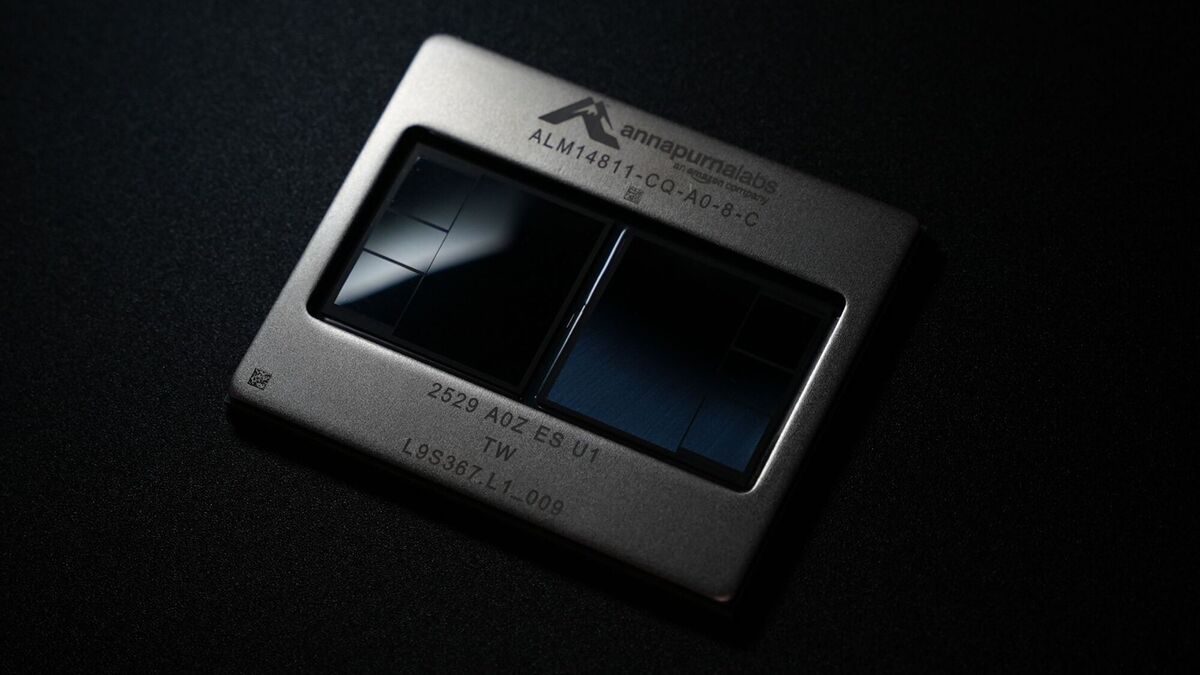
AWS has launched its latest AI training chip, Trainium3, as part of a renewed push to sell hardware that can compete with Nvidia and Google in the high-margin AI infrastructure market. The product launch is central to Amazon’s strategy to distinguish AWS within the Magnificent 7, but the company still faces adoption challenges among leading AI developers, many of whom prefer Google or Microsoft due to existing relationships (including ties to OpenAI).
Market structure: Amazon (AMZN) releasing Trainium3 is a targeted attempt to win AI-training share from Nvidia (NVDA) and Google (GOOGL) by offering lower cost-per-train alternatives to cloud-native customers. Winners are AWS (potentially gaining share in enterprise AI workloads) and data‑center operators; near-term losers are marginal GPU-resellers and any vendors exposed to price competition. Expect pricing pressure in AI-accelerator segment over 12–36 months if Trainium3 achieves >=10–20% perf/$ parity; GPU vendors retain high-value segment pricing power for top LLM training for at least 1–2 years.
Risk assessment: Tail risks include regulatory scrutiny of AWS bundling (antitrust) and Trainium3 technical underperformance vs. marketing claims, any of which could crater adoption and capex plans. Short-term (days–weeks) impact will be sentiment-driven; medium (3–9 months) depends on benchmarks/customer wins; long-term (12–36 months) hinges on ecosystem (software, frameworks, partner certifications). Hidden dependency: developer and ISV support (PyTorch/TensorFlow kernels, model zoo optimizations) will determine true adoption, not raw silicon specs.
Trade implications: Direct play — establish a modest long in AMZN (2–3% portfolio) targeting 12–18% upside in 6–12 months conditional on positive benchmarks; hedge with NVDA 3–6 month 10–15% OTM put spreads sized 30–50% of AMZN notional. Relative trades — long AMZN vs short NVDA or short select third‑party GPU cloud resellers where available; options — buy 12‑month AMZN call spreads ~+25% OTM to cap cost. Time actions to AWS third‑party benchmark releases (next 30–90 days) and first large customer announcements (3–6 months).
Contrarian angles: Consensus underestimates the importance of software/ecosystem: Graviton adoption took ~18–24 months to affect compute mix — Trainium3 likely similar, so immediate market impact may be overstated. Reaction could be underdone on AMZN upside if AWS wins large models (one >$50m annual contract could justify a >5% EPS uplift long-term) or overdone if NVDA responds with price/mix actions. Unintended consequence: aggressive pricing to gain share could pressure cloud gross margins and trigger investor rotation away from unprofitable cloud growth if not offset by incremental SaaS/API revenues.
AI-powered research, real-time alerts, and portfolio analytics for institutional investors.
Request DemoOverall Sentiment
mildly positive
Sentiment Score
0.25
Ticker Sentiment
