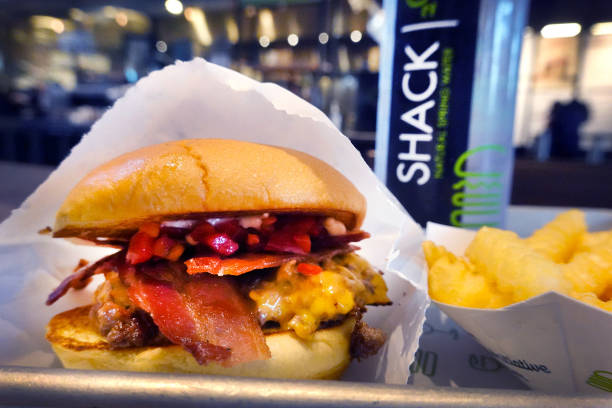
Shake Shack (SHAK) shares gained 5% after reporting strong Q3 earnings, with revenue up 15.9% to $367.4 million and net income of $12.5 million, both exceeding analyst expectations, alongside plans for significant store expansion. However, the article highlights substantial investor concerns, including macroeconomic headwinds pinching consumer spending in the fast-casual sector and projected mid-teens beef inflation for 2025-2026. Furthermore, SHAK's valuation is seen as stretched, with a P/E of 94 and a PEG ratio of 2.21, suggesting considerable downside risk given its growth rate does not justify such high multiples, particularly in a potentially slowing economic environment.
Shake Shack (SHAK) reported robust third-quarter results, with revenue increasing 15.9% year-over-year to $367.4 million and net income reaching $12.5 million, both exceeding analyst expectations by 1% and 16.1% respectively. The company achieved a 22.8% restaurant-level profit margin and plans significant expansion, targeting 90-110 new locations in fiscal 2026 as part of a strategy to nearly quintuple its store count. This performance led to a 5% intraday share price increase.
Despite strong recent performance, SHAK faces considerable macroeconomic headwinds, including pinched consumer spending across the fast-casual sector, as noted by peers. US fast food spending has plateaued in 2024-2025, with August showing minimal increase from December 2023. Furthermore, Shake Shack anticipates mid-teens beef inflation for H2 2025, extending into 2026, a critical concern given beef's significant commodity weighting and persistent supply issues.
The company's current valuation appears stretched, with a price-to-earnings (P/E) ratio of 94, triple the S&P 500 average, and a price-to-earnings-to-growth (PEG) ratio of 2.21, indicating overvaluation relative to its 16.1% year-over-year earnings growth. This contrasts sharply with Nvidia, which has a P/E of 57 and PEG of 1, supported by 59.2% earnings growth. This combination of high valuation, potential economic slowdown, and rising input costs suggests significant short-term downside risk for SHAK.
AI-powered research, real-time alerts, and portfolio analytics for institutional investors.
Overall Sentiment
strongly negative
Sentiment Score
-0.60
Ticker Sentiment
