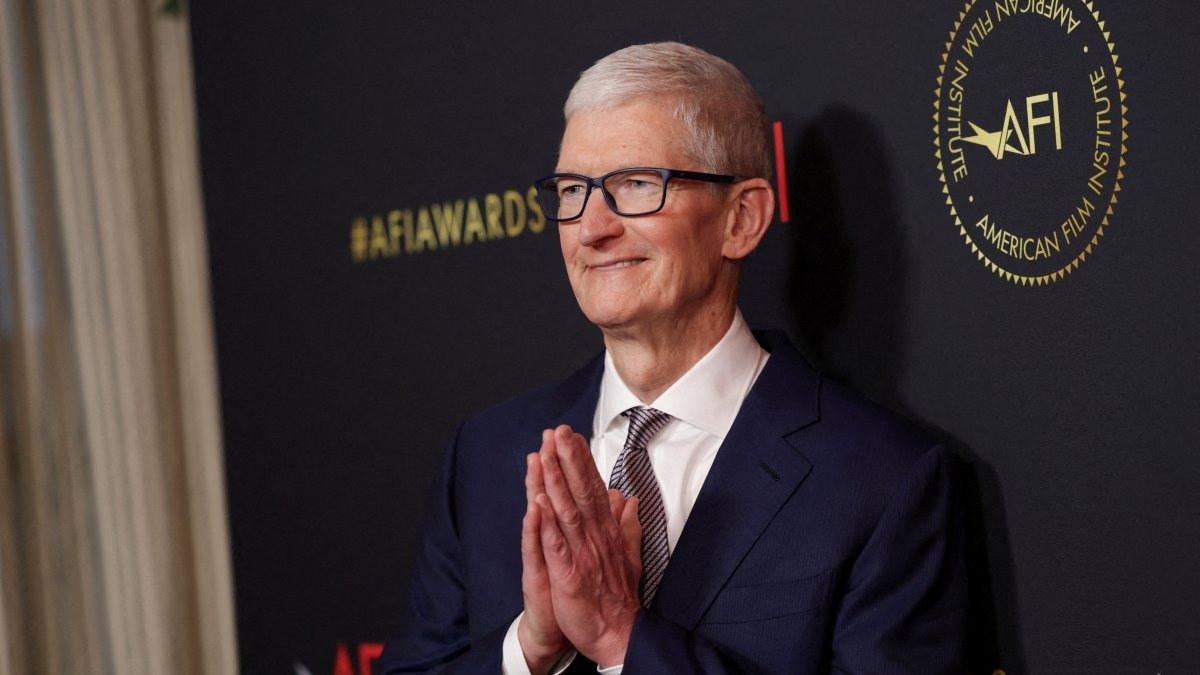
Apple announced CEO Tim Cook will step down on September 1, 2026 after nearly 15 years, with Josh Turner expected to succeed him. Cook highlighted the 2012 Apple Maps rollout as his first major mistake and cited AirPower and the self-driving car project as other regrets, while pointing to Apple Watch health features as one of his biggest wins. The article is primarily a leadership-transition and retrospective piece, with limited immediate market impact.
The market should treat this as a low-beta governance event rather than a fundamental reset. Leadership transition at this maturity level tends to compress the multiple only if it coincides with product-cycle slippage or capital allocation drift; absent that, the bigger risk is execution noise around a few flagship initiatives, not a change in Apple’s earnings power. The key second-order issue is whether the new regime remains willing to spend aggressively to fix underperforming strategic bets faster, which would be mildly negative for near-term margin optics but positive for durability of the ecosystem.
The more interesting competitive angle is that management continuity reduces the odds of a strategic pivot toward a less integrated, more financially optimized Apple. That matters for rivals because Apple’s moat is not just hardware—it is disciplined product sequencing and distribution leverage. If the next CEO leans even harder into health, silicon, and services bundling, the winners are likely to be component and manufacturing partners with high switching costs, while standalone consumer-device competitors face a more entrenched ecosystem with longer replacement cycles.
Risk is not the handoff itself but the first 2-3 product cycles after it, when the organization may overcorrect and prioritize avoiding mistakes over shipping speed. That creates a subtle bearish setup for optionality on any near-term category expansion: if ambition rises faster than readiness, launch friction can delay monetization by quarters. Conversely, if the transition is framed cleanly and the market reads it as continuity with a fresh operational mandate, the stock can re-rate on reduced leadership uncertainty and a cleaner buyback/AI roadmap narrative.
Consensus may be underestimating how much of the “story premium” was tied to a single operator rather than the institution. If investors view the change as removing one of the last large-cap founder-era proxies, the multiple risk is modestly downward; if they instead infer that the bench is strong and the machine is self-sustaining, the transition becomes a catalyst for a durability trade. In either case, the setup is more about long-duration confidence than immediate earnings revision.
AI-powered research, real-time alerts, and portfolio analytics for institutional investors.
Request TrialOverall Sentiment
neutral
Sentiment Score
0.05
Ticker Sentiment
