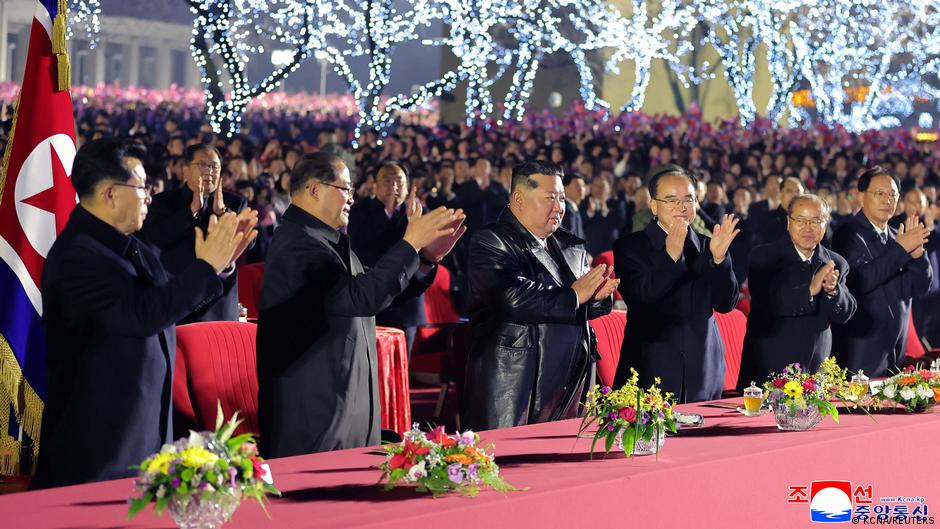
Kim Jong Un declared North Korea will "continue to consolidate our absolutely irreversible status as a nuclear power" and labelled South Korea its "most hostile" state after his reappointment and a Supreme People's Assembly session. Lawmakers approved a 2026 state budget raising defense spending to 15.8% of total expenditure and passed constitutional revisions; expect heightened regional geopolitical risk, upward pressure on defense-related assets and safe-haven flows, and increased political risk premia for Korea and nearby markets.
The geopolitical reorientation tightens the regional risk premium in a way that favors durable, multi-year procurement cycles over one-off spot orders. Expect a step-change in demand for missile systems, naval platforms and integrated air defenses (radar, EW, secure comms) that translates into multi-year revenue visibility for primes and select component suppliers; defense reorder cycles and certification timelines mean meaningful revenue reacceleration will show up in 12–36 months, with order announcements clustered around annual defense expos and government budget cycles.
Near-term market effects will be concentrated in risk assets tied to Korea/Japan trade flows and service sectors — shipping insurance rates, short-term tourism demand and regional airline load factors are the fastest to rerate (days–months), whereas capital projects (shipbuilding, land-based missile batteries, semiconductor sensor buildouts) move on procurement budgets and follow multi-year timelines. Financial plumbing — KRW, Korea sovereign CDS and regional bank funding spreads — are the quickest transmitters to equity markets and provide early indicators for escalation risk.
Second-order winners are specialized semiconductor and RF-component suppliers rather than headline primes: lower-volume, higher-margin suppliers of GaN/GaAs amplifiers, AESA radar semiconductors and secure comms modules will see disproportionate margin expansion as militaries prioritize resilient, trusted suppliers. Conversely, consumer discretionary and travel exposure in Korea/Japan are the most direct losers; narrowing of carry trades into KRW and reallocation into safe-haven assets could amplify FX moves beyond fundamentals if provocations accelerate.
The main potential reverser is diplomacy or a credible confidence-building measure that removes ambiguity (sanctions relief or verified denuclearization steps); absent that, the baseline is an elevated, structural uplift in defense spending regionally. Market complacency about the speed of procurement cycles is the likely source of mispricing — risk is asymmetric: fast downside to regional beta, slower but persistent upside to defense-related revenue streams.
AI-powered research, real-time alerts, and portfolio analytics for institutional investors.
Request DemoOverall Sentiment
strongly negative
Sentiment Score
-0.60
