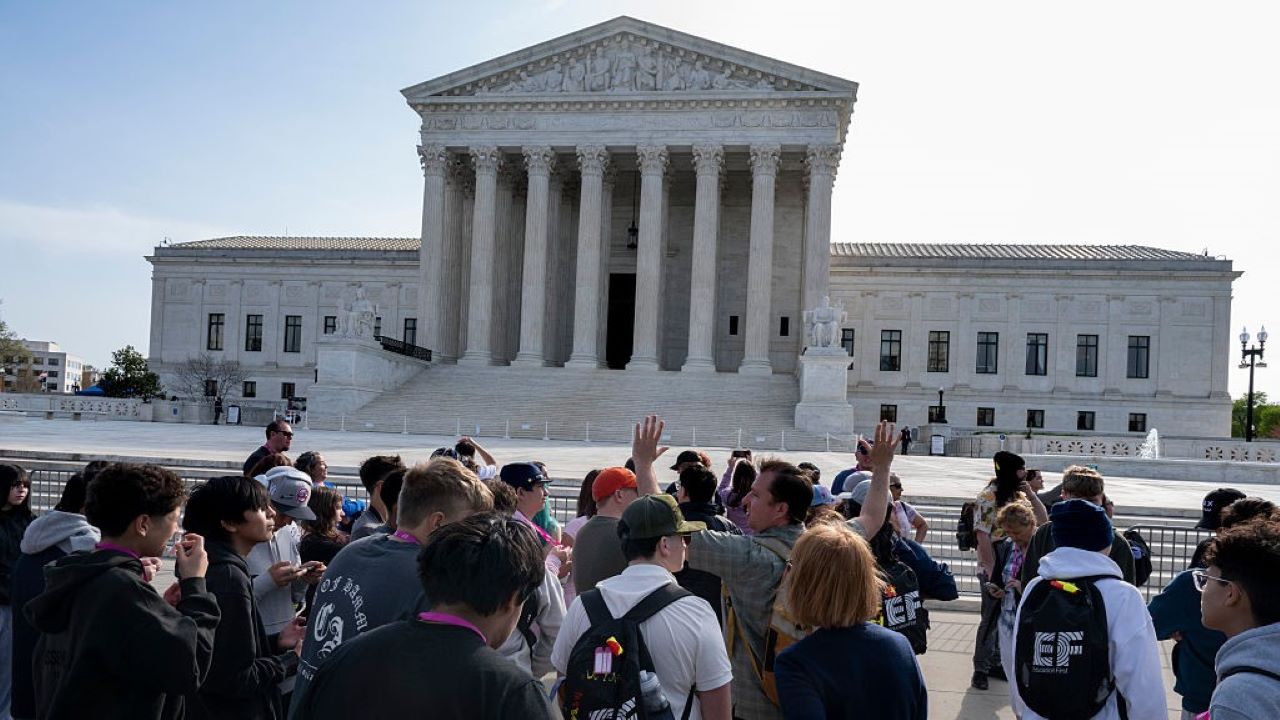
The Supreme Court is hearing oral arguments in Trump v. Barbara over President Trump's executive order seeking to end birthright citizenship; Solicitor General John Sauer argued for narrowing the 14th Amendment while ACLU legal director Cecillia Wang will argue against the order. President Trump attended the arguments (the first sitting president to do so), and a ruling could affect roughly 150,000–200,000 children born annually to non‑citizen parents and produce immediate legal and operational consequences depending on its scope.
The oral argument dynamics indicate the Court is actively seeking a narrow doctrinal route rather than a broad policy rewrite; that raises the odds of a close, technical opinion or a split decision that leaves major operational questions for the executive branch and Congress. Market response should be framed as legal binary risk with concentrated volatility around the decision window (days–weeks) rather than an immediate macro shock — the economic pathways (healthcare costs, travel demand, state budgets) operate on quarters to years.
Second-order winners/losers are likely to be regional and service providers exposed to discretionary cross‑border travel and maternity-related care (hospitals, specialty insurers, hospitality near international gateways), plus firms whose valuations are sensitive to policy-driven regulatory uncertainty (regional banks in immigrant‑heavy metros). However, any real cash‑flow impact will be muted near-term because administrative implementation, follow‑on litigation, and statutory fixes would be required to change on‑the‑ground eligibility; this creates a stretched timeline for material revenue effects (6–36 months).
Key catalysts and tail risks: the Court’s opinion text (narrow statutory/dismissal vs. broad constitutional holding) is binary and will determine whether markets face immediate policy drift or a prolonged legislative fight. A broad ruling could force near-term executive clarifications and state-level litigation, producing multi-week risk‑off moves; a narrow/technical ruling materially reduces economic transmission and creates a buy‑the‑dip setup. Watch post‑opinion federal administrative guidance and Congressional action windows (30–180 days) as the true drivers of durable sectoral impact.
AI-powered research, real-time alerts, and portfolio analytics for institutional investors.
Request DemoOverall Sentiment
neutral
Sentiment Score
0.00
