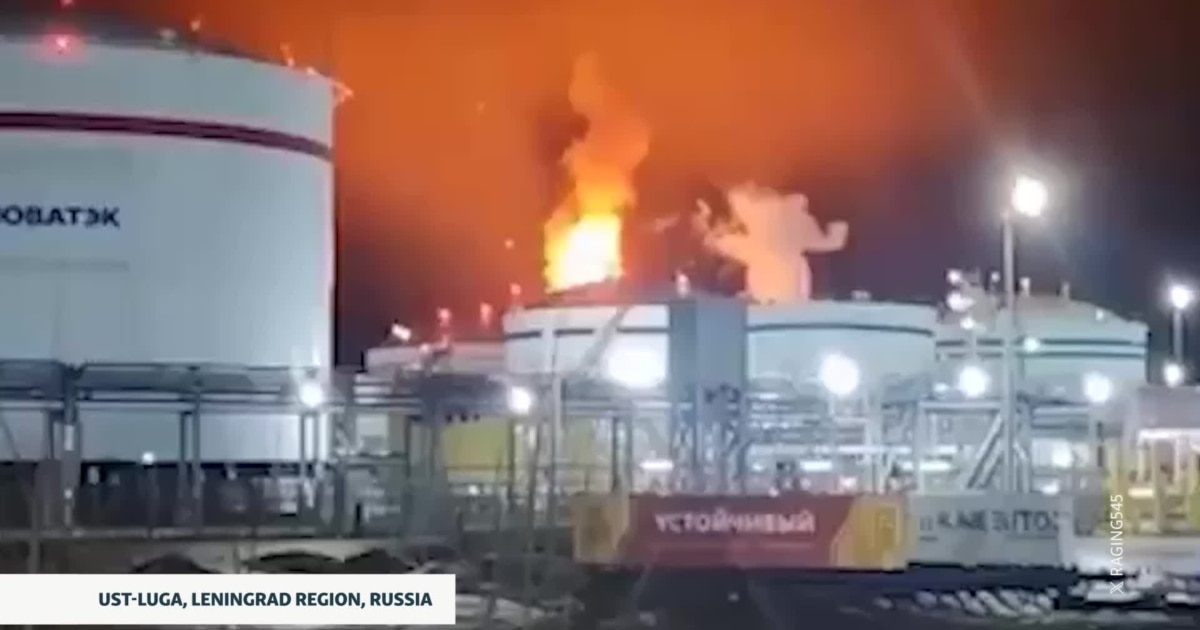
Nearly 400 Ukrainian drones struck over 10 Russian regions including the Baltic Sea oil-export port Ust-Luga on March 25; Reuters estimates the strike shut roughly 40% of Russia's crude export capacity (~2 million barrels per day). The assaults (and prior strikes this month on Novorossiisk and Primorsk) represent a clear escalation against Russian energy infrastructure and coincide with reciprocal Russian drone attacks inside Ukraine, driving regional power outages and civilian casualties. Expect upward pressure on global oil prices, elevated volatility across energy and shipping sectors, and increased risk premia—recommend monitoring oil market moves, export/transport disruptions, and any sanctions or policy responses.
The strikes will keep near-term oil and refined-product volatility elevated by constraining seaborne export optionality and increasing insurance and rerouting costs; historically, similar disruptions translate into multi-dollar-per-barrel squeezes within days and a multi-week period of heightened backwardation that benefits holders of physical storage and margin capture strategies. Higher freight/insurance and displaced loadings will compress refinery yields for import-dependent regions while enlarging arbitrage opportunities for producers able to redirect cargoes to alternative terminals, creating durable winners among flexible shippers and storage owners.
Second-order effects will show up in Europe’s refining and logistics complex: port congestion, rebooking to southern transits, and increased inland pipeline utilizations are likely to raise landed feedstock costs for particular refineries by a non-trivial percentage, widening regional crack dispersion for 1–6 months. Energy capex dynamics also shift — sustained elevated price realizations over quarters will accelerate US upstream cash returns and encourage restart decisions, but most large rerouting and infrastructure fixes take months-to-years, locking in a period of structural margin divergence.
Key risk channels and catalysts are asymmetric: near-term price spikes can be reversed within weeks by strategic releases, sudden restoration of export terminals, or a credible diplomatic de-escalation; conversely, escalation into broader regional conflict or explicit targeting of midstream chokepoints would produce multi-month upside to oil and defense equities. Monitor backwardation term structure, freight/insurance spreads, and European refinery runs as high-frequency indicators that will precede fundamental repositioning.
AI-powered research, real-time alerts, and portfolio analytics for institutional investors.
Request DemoOverall Sentiment
strongly negative
Sentiment Score
-0.65
