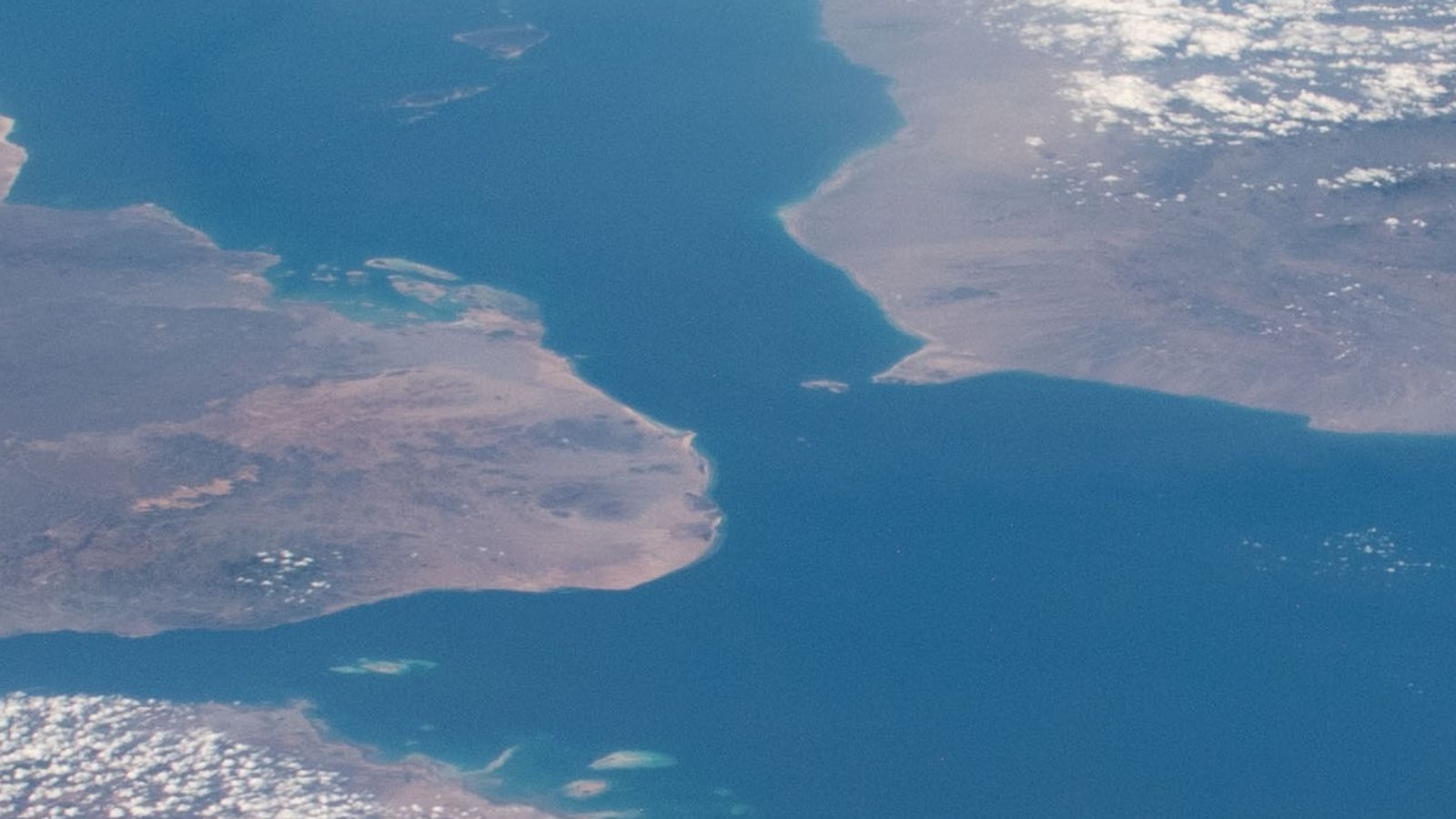
About 25% of global container trade transits the 20-mile-wide Bab el Mandeb; major carriers (Maersk, Hapag-Lloyd, CMA CGM) are rerouting around the Cape of Good Hope, lengthening voyages and raising fuel costs. Carriers have implemented war-risk and deviation surcharges of $1,500–$3,300 per standard container; prior Houthi attacks (100+ merchant vessels between Nov 2023–Jan 2025, 2 sunk, 4 fatalities) underline the elevated operational risk. Disruption of Bab el Mandeb would exacerbate existing Strait of Hormuz disruptions, risk further upside pressure on crude prices and broad trade-cost inflation, and represent a market-level geopolitical shock to global shipping and energy markets.
The immediate market impact is transmission through maritime economics, not just tanker routes: longer detours materially reduce effective fleet capacity because ships spend more days steaming and less time earning spot revenue. A conservative working estimate: a sustained reroute that adds even a few days per Asia-Europe round trip equates to a 5–15% hit to effective container lift capacity, which supports spot freight rates and war-risk surcharges for quarters rather than days.
Second-order winners are players who capture incremental pricing power or fixed-fee terminal throughput — large integrated carriers, Atlantic/Med transshipment hubs, and owners of long-haul tanker tonnage — while thin-margin forwarders, just-in-time supply chains (auto/electronics), and Suez-dependent service providers are exposed to margin erosion and demand destruction. Expect freight derivatives and time-charter markets to reprice quickly; container lines can monetize via routable surcharges, but their unit economics will diverge depending on fuel hedges and contract mix.
Tail risks skew to escalation: a sharp spike in insurance premiums or a durable campaign against convoys would cause a non-linear shock to trade flows and could rerate global trade multiples within weeks. Conversely, coordinated naval protection or a diplomatic settlement can revert most of this repricing within 1–3 months; monitor bunker crack spreads, Baltic/Container indices, and port call patterns as high-frequency indicators of persistence.
AI-powered research, real-time alerts, and portfolio analytics for institutional investors.
Overall Sentiment
strongly negative
Sentiment Score
-0.60
