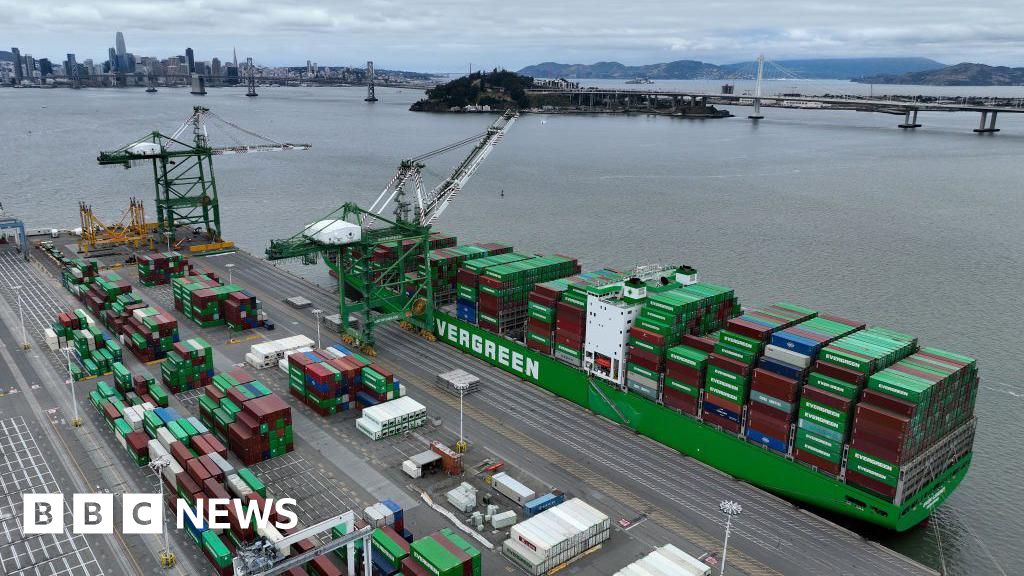
The US goods trade deficit widened 2.1% versus 2024 to roughly $1.2 trillion as goods imports reached a record $3.4 trillion, while the overall goods-and-services deficit was $901.5 billion (near $903.5 billion in 2024). Imports of computer parts and equipment surged on business investment in AI even as exports hit a high and trade with China fell (bilateral deficit down ~30% to $202.1 billion); policymakers’ sweeping tariffs of at least 10% have so far not reduced the aggregate deficit and face legal and policy uncertainty, including a Supreme Court challenge and executive actions tied to Iran-related trade.
Market structure: Persistent record goods imports ($3.4tn) driven by AI capex (computer parts/equipment) means semiconductor manufacturers and global electronics exporters (Taiwan, Korea) plus freight/ports are near-term winners while US cyclical exporters (autos, agriculture) face demand/competitiveness pressure. Tariffs have so far failed to arrest import volumes due to front‑loading and limited alternative capacity, preserving pricing power for offshore suppliers and shipping firms rather than immediate reshoring gains.
Risk assessment: Key tail risks are a Supreme Court ruling within 1–3 months that voids tariffs (sharp volatility) or new executive tools that reintroduce friction (weeks–months); macro shocks (US recession) could collapse import demand and flip winners to losers. Hidden dependencies include inventory destocking timing (3–9 months) and concentrated supplier capacity in Taiwan/Vietnam—small supply shocks could spike component prices.
Trade implications: Tactical exposure to semiconductor equipment (ASML, LRCX) and logistics (UPS, FDX) is warranted for 3–12 month horizons as AI capex supports imports; defensively short US export-sensitive names (F, GM, agricultural ETF DBA) for the same window. Use 6–12 month call spreads on LRCX/ASML to capture upside while buying 3–6 month put spreads on DBA/DE to hedge downside from weaker exports.
Contrarian angle: Consensus underestimates durable AI-driven import demand despite tariffs—this structurally favors offshore semiconductor suppliers and logistics for 12–24 months. Historical precedents (early 2000s tariffs) show reshoring takes years; therefore markets that price near-term reshoring gains are likely mispriced and offer alpha by favoring supply-chain beneficiaries over domestic cyclicals.
AI-powered research, real-time alerts, and portfolio analytics for institutional investors.
Request DemoOverall Sentiment
moderately negative
Sentiment Score
-0.35
Ticker Sentiment
