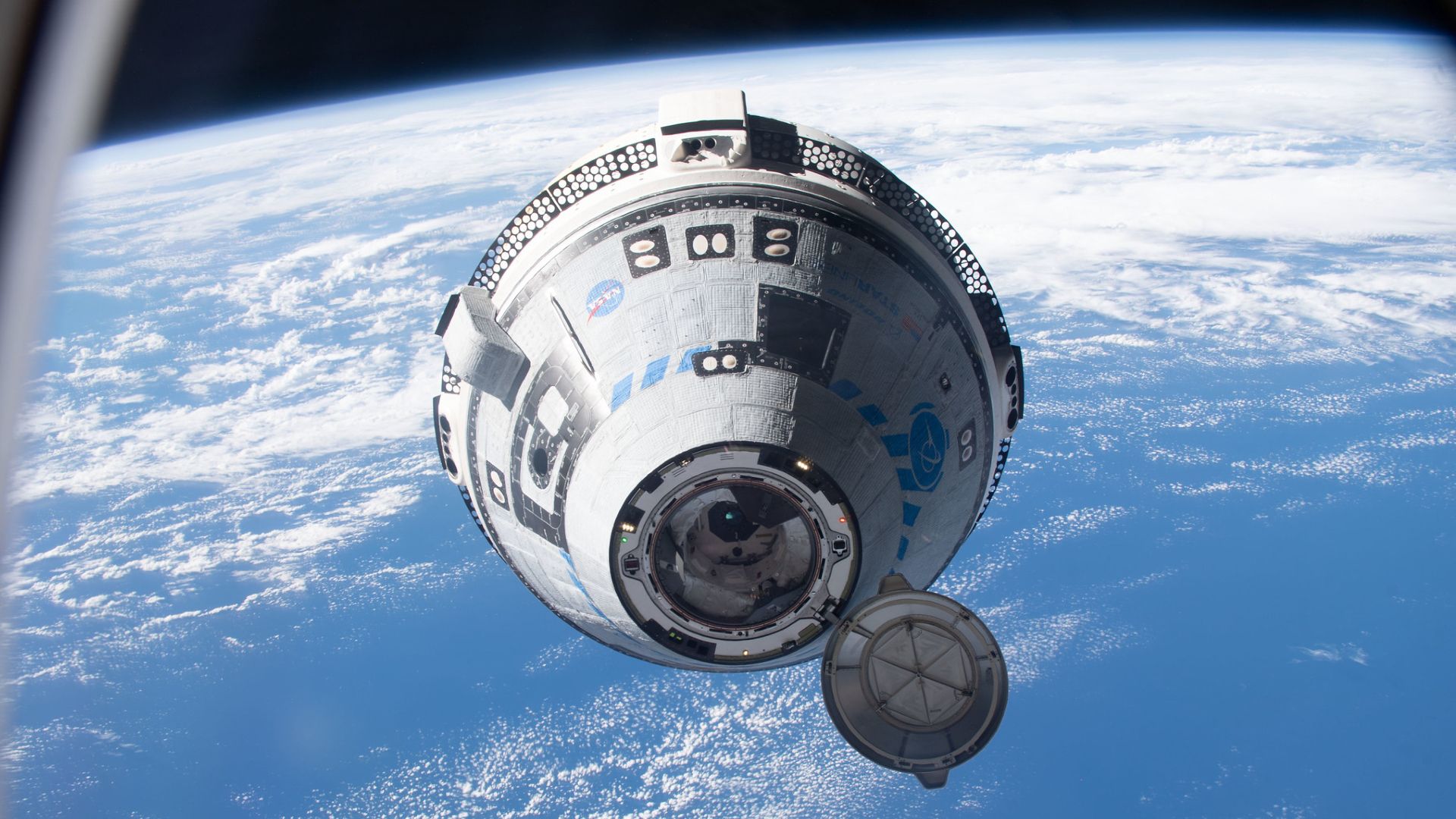
NASA and Boeing agreed the next Starliner mission (Starliner-1) will launch no earlier than April 2026 and carry only cargo, not crew, as Boeing continues to address thruster system issues after the troubled Crew Flight Test in 2024. Under the original 2014 $4.2 billion contract for up to six crew rotation flights, NASA and Boeing have reduced the guaranteed crewed missions by at least two (now up to four firm flights, with two as options), a move that delays Boeing’s operational crew cadence, shifts near-term revenue/timing risk, and further entrenches reliance on SpaceX for astronaut transport. NASA will continue testing propulsion modifications through 2026 while aligning Starliner flight planning with ISS operational needs through the station's planned 2030 retirement.
Winners are parties capturing near-term crew transport share — principally SpaceX (and its suppliers) — and large defense primes (LMT, NOC, RTX) that will pick up incremental NASA/DoD spend or ISS sustainment work; Boeing takes immediate revenue/timing pain (roughly $700M/flight × 2 ≈ $1.4B of guaranteed crew-flight economics deferred) and reputational hit. Competitive dynamics shift pricing power toward SpaceX for crew rotations through at least 2026–2030, compressing Boeing’s ability to extract premium per-flight pricing while increasing demand elasticity for alternative services.
Tail risks include a cascading technical failure or further schedule slips that lead NASA to reallocate missions (5–15% scenario) or impose penalties, which could knock Boeing equity down >30% on realization; regulatory/antitrust scrutiny of concentrated crew transport (SpaceX) is a 10–25% probability multi-year event that would reshuffle contract economics. Immediate (days) will be headline-driven equity/option volatility, short-term (weeks–months) driven by test outcomes and contract renegotiation, long-term (years) governed by ISS retirement (2030) compressing monetization windows.
Trade implications: bias to underweight Boeing (BA) and overweight defense primes (LMT, NOC, RTX) and select launch/satellite suppliers; implement long-dated downside protection on BA and capture relative upside in LMT/NOC via outright longs or pairs. Options: buy 12–24 month puts on BA (20–30% OTM) to hedge and sell nearer-term puts to finance; consider a BA vs LMT pair (long LMT, short BA) to isolate program-specific execution risk.
Contrarian angles: market may be overpricing permanent loss of Starliner revenue — a successful 2026 propulsion fix could restore multiple expansion and accelerate deferred revenue recognition (up to $1.4B swing). Historical parallels (airframe program recovery post-technical crises) show 12–36 month rebounds are possible; unintended consequence: overreliance on SpaceX raises political/regulatory risk that could re-diversify contracts back to Boeing, creating a mean-reversion trade if you buy the turnaround after validated tests.
AI-powered research, real-time alerts, and portfolio analytics for institutional investors.
Request DemoOverall Sentiment
moderately negative
Sentiment Score
-0.40
