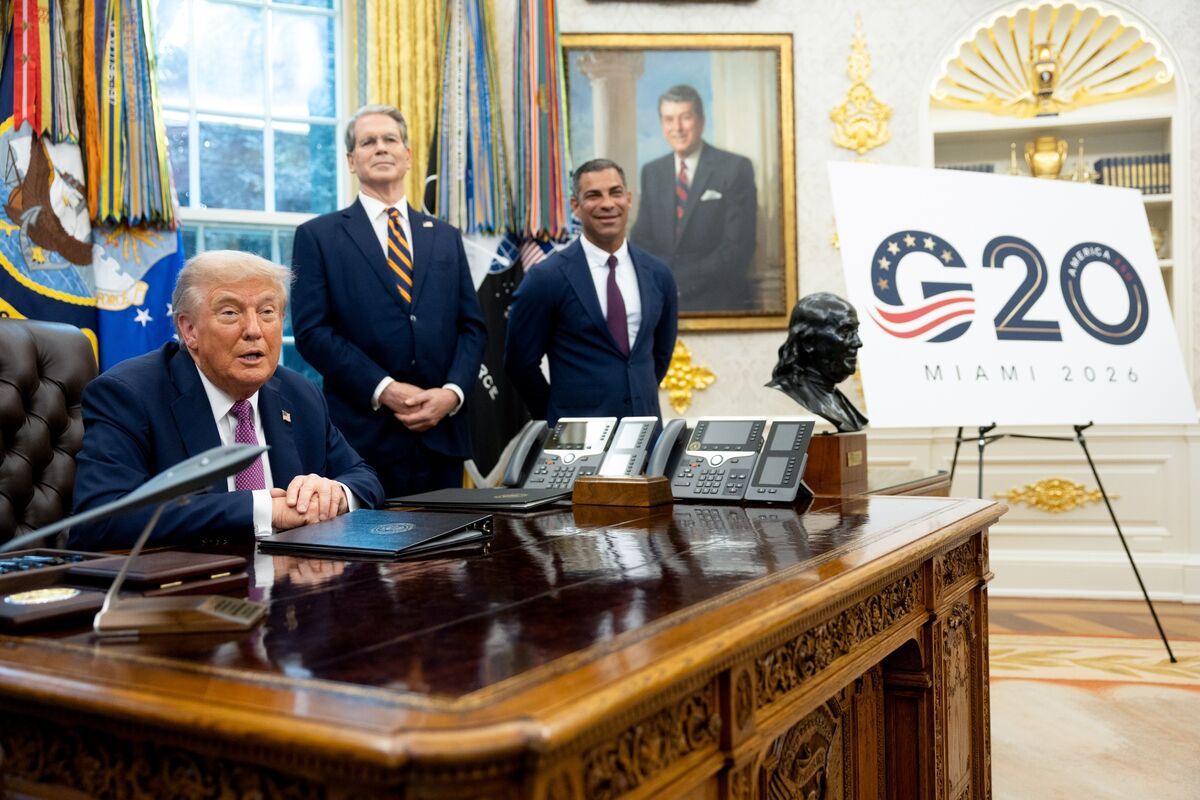
President Donald Trump announced via social media that next year’s G-20 summit will be an invite-only event held at his private Miami golf resort and that he will not invite South Africa, the holder of this year’s G-20 presidency. The declaration personalizes control over a major diplomatic forum and could heighten bilateral tensions with South Africa and raise questions about U.S. stewardship of multilateral gatherings, but it is unlikely to have direct material market consequences.
Market structure: An invite-only G‑20 hosted at a private US resort is largely a geopolitical signal rather than an economic shock; direct winners are niche security/construction contractors and luxury private hospitality players while broad hospitality and local Miami travel demand may see a modest negative displacement versus a typical open summit. EM assets tied to the snub—notably South Africa (ZAR, EZA ETF, SA sovereign credit)—face asymmetric downside risk as diplomatic friction can amplify capital outflows and FX volatility over 1–6 months.
Risk assessment: Tail risks include a sustained diplomatic rupture (reciprocal exclusions, trade frictions, or BRICS coordination) that could widen South African sovereign spreads by 100–300bp and push ZAR 8–15% weaker over quarters; low probability but high impact. Near term (days–weeks) volatility is the main exposure; medium term (3–12 months) credit & commodity flows matter, including PGM supply sentiment that could move palladium/platinum prices.
Trade implications: Tactical trades favor short SA beta and EM risk-off hedges and selective long safe havens. Specific mechanisms: short EZA or buy USDZAR forwards, buy 3‑6 month EZA puts (5–15% OTM), and add tactical exposure to gold (GLD/IAU) or 10‑year USTs (TLT) if VIX breaches 20; hotel/airport travel names in Miami (HST) could be small shorts if early booking data shows >3% RevPAR weakness.
Contrarian angles: The market may underprice political-exclusion spillovers—this kind of protocol breach can nudge longer-term fragmentation of multilateral forums, benefiting defense contractors and non‑China commodity suppliers over 12–36 months. However, historical precedents (short diplomatic snubs) show limited market follow‑through absent trade measures; therefore size positions modestly and size up only if concrete retaliatory steps or >3% FX moves occur.
AI-powered research, real-time alerts, and portfolio analytics for institutional investors.
Request DemoOverall Sentiment
neutral
Sentiment Score
0.00
