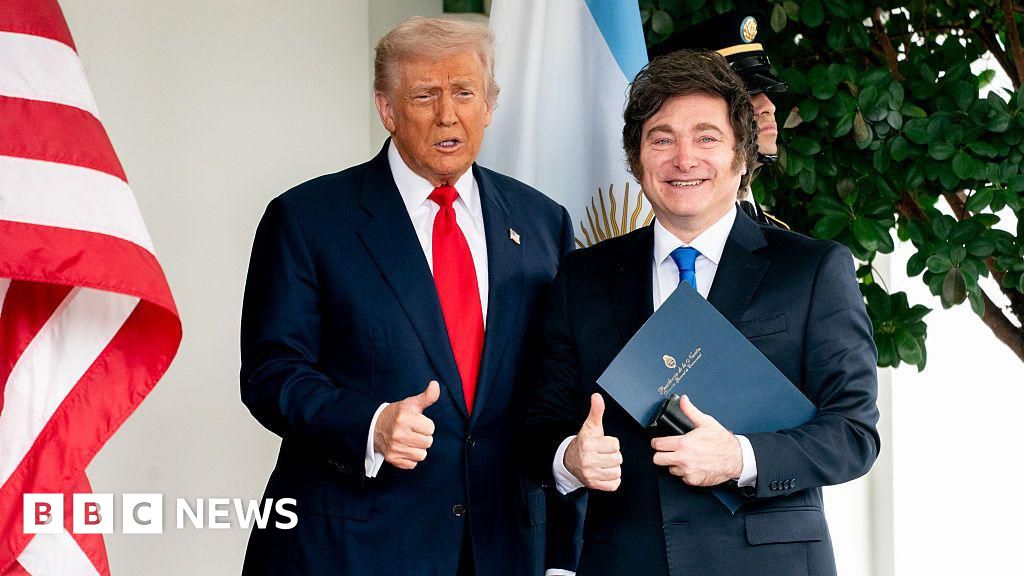
The US Treasury intervened to stabilize the Argentine peso last year by purchasing pesos, extending a swap line and ultimately settling the swap in December; it traded $2.5bn of pesos for dollars out of a possible $20bn and separately provided $872m tied to IMF-held reserves. Treasury chief Scott Bessent says the US has been repaid, holds no pesos in its exchange stabilization fund and generated 'tens of millions' in profit, but analysts warn the gains are small relative to the scale of Argentina's reserve depletion and that structural risks remain as Argentina may be relying on external rescues rather than rebuilding reserves.
Market structure: The US swap line acted as a discrete liquidity backstop that temporarily compressed USD-ARS volatility and tightened Argentine sovereign premia; winners are short-term peso holders, Argentine equity ETF holders (e.g., ARGT), and local banks able to rebuild FX access, while exporters/import-competing domestic sectors may face renewed exchange-rate uncertainty. Supply/demand shifted from forced-sell to buy-on-stability: only $2.5bn of a possible $20bn was used, implying latent demand for USD liquidity remains and pricing power still skews to USD holders.
Risk assessment: Key tail risks are abrupt policy reversal (Milei backtracking on reforms), US political withdrawal of future swaps, or a large reserve drawdown causing renewed FX pressure — any of which could widen Argentina sovereign CDS by +500–1,000 bps in weeks. Immediate (days) risk is volatility repricing; short-term (0–6 months) depends on reserve rebuild pace and IMF reviews; long-term (>1 year) outcome depends on fiscal reforms, with binary default vs sustained stabilization outcomes.
Trade implications: Tactical, sized and hedged EM plays are appropriate: favor small, event-driven longs in ARGT and EM local-currency debt exposure (EMLC) with explicit stop-loss and CDS hedges rather than naked exposure to sovereign bonds. Use options to asymmetrically express upside (6–12 month calls) and buy CDS protection if spreads re-widen above set thresholds; avoid large unhedged positions until Argentina adds $5–10bn of usable reserves.
Contrarian angles: The market treats US support as a recurring safety net — that complacency is the mispricing. The “success” headline understates Argentina’s reserve depletion and moral hazard; a 2nd-order risk is accelerated capital outflows if Washington’s political calculus changes, so current rallies are likely overdone without demonstrable reserve rebuilding of at least $5bn–$10bn over 3–6 months.
AI-powered research, real-time alerts, and portfolio analytics for institutional investors.
Request DemoOverall Sentiment
mildly positive
Sentiment Score
0.25
