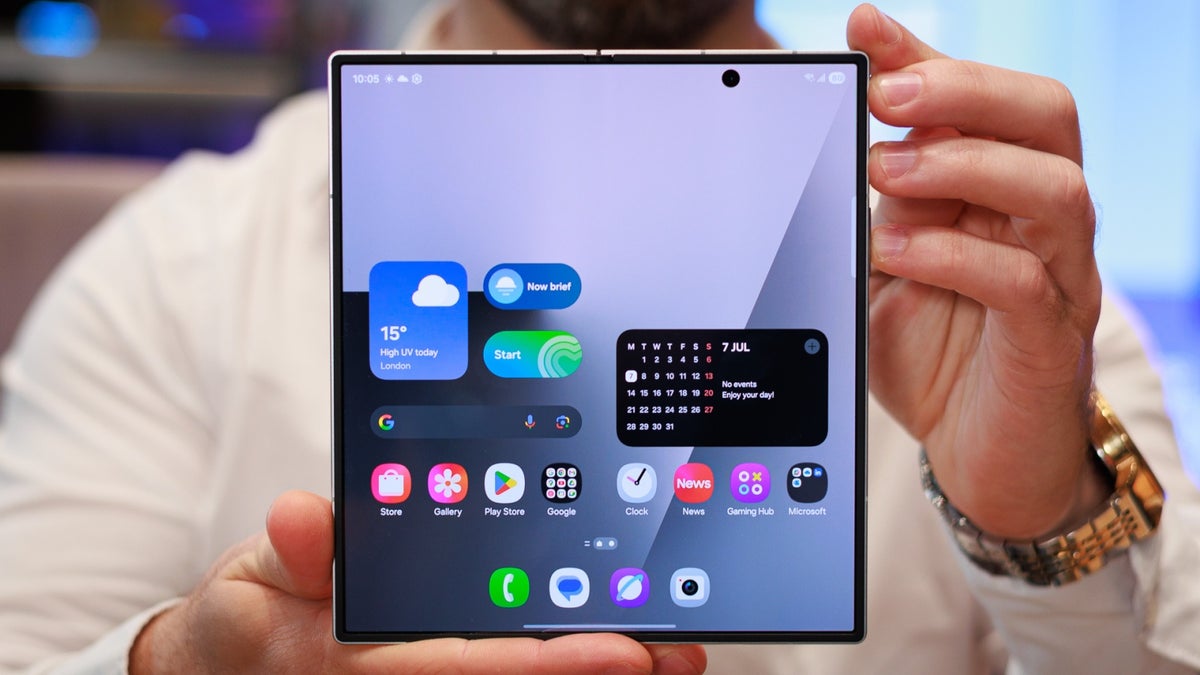
Samsung's upcoming Galaxy Z Fold 8 and Wide Fold are reported to support 45W wired charging (up from 25W on the Z Fold 7, an 80% increase) and to sport larger batteries — ~5,000mAh for Fold 8 (+600mAh, ~14%) and ~4,800mAh for Wide Fold (+400mAh, ~9%). Estimated real-world charging time could fall from ~83 minutes on the Z Fold 7 to ~60 minutes if 45W is realized. Competitors already offer faster charging (60W on Samsung S26 Ultra, 80W on Motorola Razr Fold/OEMs), so the upgrade improves Samsung's foldable competitiveness ahead of a likely Apple foldable launch but is not market-disruptive.
Samsung’s incremental hardware improvements remove an easy talking point for differentiation and accelerate a shift in competition from singular product specs to ecosystem and services monetization. That favors incumbents who can translate hardware parity into recurring revenue — a secular advantage for an ecosystem player that already monetizes hardware through services and high ASPs.
For component suppliers and OEMs, the next 12–24 months will see margin pressure as fast-followers compress the value of discrete hardware advances; winners will be firms selling enabling platforms (OS-level UX, hinge/thermal modules, folding displays) where switching costs are higher. Expect supply chains to bifurcate: commoditized parts face price deflation within a year while specialty components with tight IP retain pricing power.
Apple’s anticipated entry is the biggest structural catalyst — not because it will immediately outsell incumbents, but because its distribution and marketing will force faster feature parity and push OEMs to compete on price/perceived value rather than raw specs. In the near term (months), sentiment will swing on product launches; over 6–18 months, market share shifts and margin outcomes will matter more, and hardware makers that can’t migrate value to software/services will face compressing multiples.
Key tail risks: Apple’s product could disappoint, reversing the premium-bifurcation narrative; macro consumer weakness could delay upgrade cycles by 6–12 months; and component shortages or patent disputes could create ephemeral winners. Monitor device ASPs, services ARPU trends, and EFI/UX announcements as high-frequency indicators of which strategy is working.
AI-powered research, real-time alerts, and portfolio analytics for institutional investors.
Request DemoOverall Sentiment
mildly positive
Sentiment Score
0.15
Ticker Sentiment
