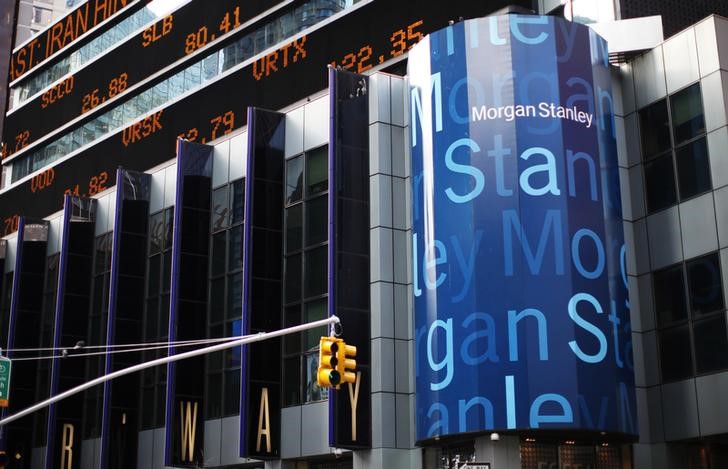
The Federal Reserve Board approved an exemption under Section 23A permitting Morgan Stanley Bank, N.A. to acquire Morgan Stanley Europe SE and its German bank as part of a one-time internal reorganization; the covered transaction is valued at billions as of Sept 30, 2025 and exceeds statutory 23A quantitative limits. ECB approved MSESE's conversion on Jan 16, 2026 (completed Jan 19, 2026); the Board found the acquisition in the public interest and noted MS Bank is/would be well capitalized with loss-protection commitments, but four Board members dissented and Governor Barr warned the move could pull over $1.5 trillion of foreign nonbank activity into the federal safety net, raising regulatory and systemic-risk considerations.
This exemption effectively creates a funding arbitrage pathway: deposit-like funding can be routed to finance higher-yielding trading and capital-markets inventory in a structurally cheaper way than wholesale funding. If even $50–100bn of trading assets migrate onto deposit funding with a 25–50bp funding cost advantage, that’s approximately $125–500m of incremental pre-tax income per year — enough to move MS’s ROE by several hundred basis points absent offsetting capital charges.
Competitively, the decision is a two-edged sword. It gives the bank a transient edge versus peers that don’t have the same legal structure, pressuring competitors to seek similar carve-outs or to raise returns elsewhere; at the same time it compresses margins in peripheral financing businesses (prime brokerage, repo providers) as deposits bid returns down, creating winners among low-cost deposit franchises and losers among wholesale-funded intermediaries.
Regulatory and political tail risk is the dominant offset: visible dissent from senior regulators increases the probability of broader rulemaking or targeted constraints within 6–24 months, which could impose capital add-ons or limit the scale of migration. Near-term catalysts to watch are public congressional inquiries, Fed/OCC follow-ups, MS disclosures on how much of the European trading book will be absorbed, and quarterly earnings guidance revisions.
The consensus will likely focus on an immediate earnings uplift and underweight longer-term policy risk. That sets up an asymmetric trade where you can capture near-term upside while hedging the meaningful—but binary—regulatory reversal risk that would reprice these benefits quickly.
AI-powered research, real-time alerts, and portfolio analytics for institutional investors.
Request DemoOverall Sentiment
neutral
Sentiment Score
0.00
Ticker Sentiment
