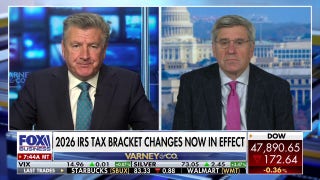
Former Treasury deputy Michael Faulkender forecasts that the Trump administration’s 2025 tax package (the 'Big Beautiful Bill Act') and rollbacks of Biden-era energy restrictions will drive stronger economic performance into 2026, citing large tax refunds due in February–March and the administration’s second- and third-quarter strength. He notes oil at roughly $57/barrel (about 28% below the January 2025 high of $78.70) and U.S. inflation at 2.7% in November (year low 2.3% in April, peak 3% in September) as factors that have not yet fully fed through the economy; Faulkender left his deputy Treasury role in August after serving earlier as acting IRS commissioner.
Market structure: The near-term winners are low-cost onshore US E&P and service names (EOG, PXD, XOP) and refiners (VLO, PSX) as federal-land production and deregulatory moves lower marginal cost and feedstock prices; marginal producers with break-evens >$60 suffer. Deregulation + tax refunds (Feb–Mar) boosts household discretionary cash flow by an estimated few hundred dollars per household, favoring retail and travel demand into Q1–Q2 2026. Cross-asset: lower oil toward the $50–$60 band should be disinflationary—supporting long-duration Treasuries (TLT) and compressing real yields, while pressuring oil-linked FX (CAD, NOK) and volatility in energy options.
Risk assessment: Tail risks include an OPEC+ surprise cut or Middle East shock sending Brent >$80 within weeks, or fiscal stimulus reigniting CPI >3.5% prompting Fed hikes and steepening term premium. Time horizons matter: oil/inventory shocks play out in days–weeks; tax-refund driven consumption is a concentrated Q1 effect; structural deficit/term-premium impacts unfold over 12–36 months. Hidden dependencies: state permitting, local infrastructure (pipelines/rail) and capex discipline among independents could flip supply dynamics quickly. Key catalysts: weekly EIA stocks, OPEC meeting dates, Fed dot plots, and Treasury issuance calendar.
Trade implications: Favor tactically overweight Energy (2–4% active overweight) with 6–12 month horizon: buy EOG (3%) or XOP (2–3%) and refiners VLO/PSX (1–2% each). Hedge with 1–2% TLT long as disinflation insurance. Options: buy 6–9 month call spreads on EOG (buy a near-the-money, sell ~25% OTM) to cap cost while capturing a $15–30/bbl rebound scenario; sell iron-condors on WTI futures if inventory prints show rangebound $48–68.
Contrarian angles: Consensus assumes tax cuts + energy supply = sustained growth without inflation; missing are one-off timing (refunds concentrated in Q1) and higher deficits driving term premiums over 12–36 months, which would hurt growth multiple expansion. The market may underprice a future supply crunch if capex stays subdued—a regime that would send oil >$75 in 2027; conversely, an immediate price collapse to <$45 would stress high-yield energy credits. Monitor EIA stocks, Fed PCE prints, and Treasury issuance as 3 concrete triggers to add/trim positions.
AI-powered research, real-time alerts, and portfolio analytics for institutional investors.
Request DemoOverall Sentiment
mildly positive
Sentiment Score
0.30
