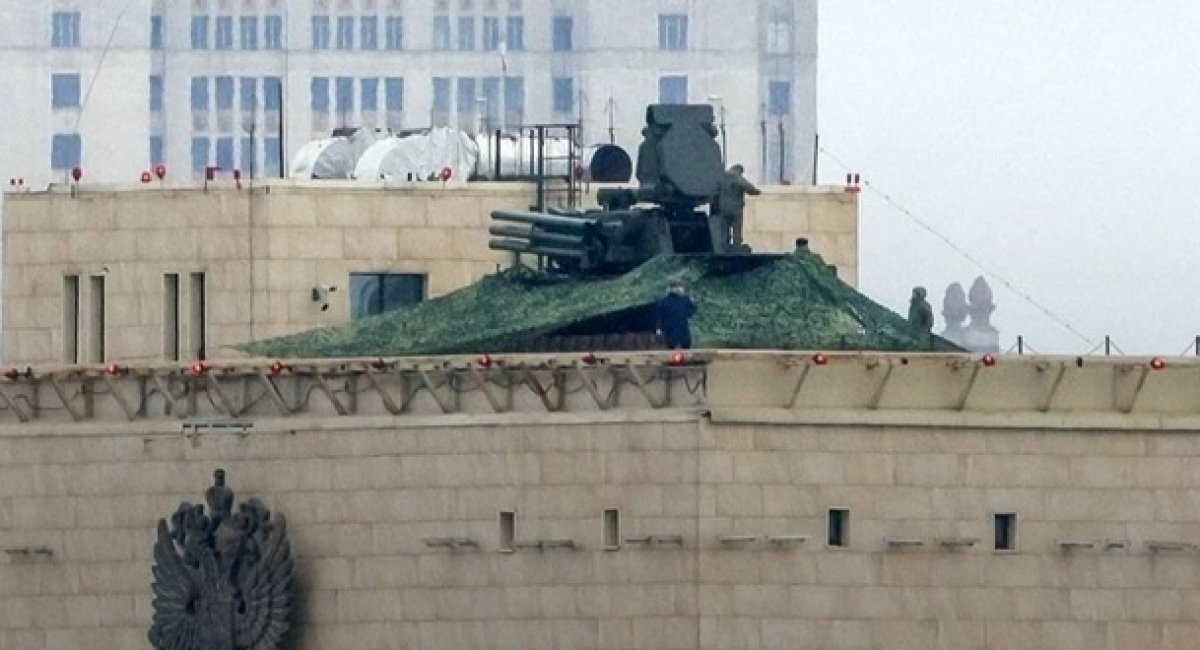
Russia has now deployed at least four Pantsir air defense systems on Moscow rooftops, including a newly installed Pantsir-SMD-E at the Nord Star business center. The article highlights the expansion of Moscow’s layered air defenses around the Kremlin and warns that placing military systems on civilian buildings increases risks to nearby residents and may create legitimate military targets under international humanitarian law. The news is strategically important but primarily geopolitical rather than market-moving.
The key market takeaway is not the hardware itself but the signal that Moscow is normalizing expensive point-defense around political and command nodes rather than accepting broader urban exposure. That implies a slow-burn increase in defense capex, mobility demand, and maintenance intensity for Russian air-defense supply chains over the next 6-18 months, even if headline procurement budgets do not rise sharply. The more important second-order effect is that this type of deployment suggests the drone threat is being judged persistent, not episodic, which raises the floor for electronic warfare, radar, and short-range interceptor demand.
For western markets, the more relevant read-through is operational rather than direct equity exposure: the longer Russia is forced into dense, layered urban air defense, the harder it becomes to preserve high-value command continuity while absorbing attritional drone pressure. That usually pushes adversaries toward cheaper, more numerous attack vectors and forces defenders into a cost-exchange problem where each interception compounds budget burn. If the trend continues, expect more visible stress on Russian industrial firms that support mobility, heavy-lift aviation, optics, and guided-missile replenishment, while the civilian infrastructure risk premium inside Moscow remains elevated.
The contrarian angle is that rooftop deployments may be more about optics and regime assurance than pure military efficiency. If so, the incremental deployments could be more limited than the market narrative implies, because there is a finite number of prestige sites where the political payoff justifies the operational and legal costs. But if another wave of rooftop systems appears, it would be a strong indicator that drone penetration is still worsening faster than Russia can harden lower-altitude defenses, which is bullish for the persistence of the Ukraine drone campaign and bearish for Russian confidence in rear-area sanctuary.
AI-powered research, real-time alerts, and portfolio analytics for institutional investors.
Request TrialOverall Sentiment
moderately negative
Sentiment Score
-0.20
This is a medium-horizon story, not a one-day catalyst. The near-term tradeable implication is rising tail risk around Moscow infrastructure and any companies tied to Russian domestic air-defense logistics, with the broader strategic impact showing up over quarters as Russia reallocates resources toward air-defense saturation rather than offensive modernization.
