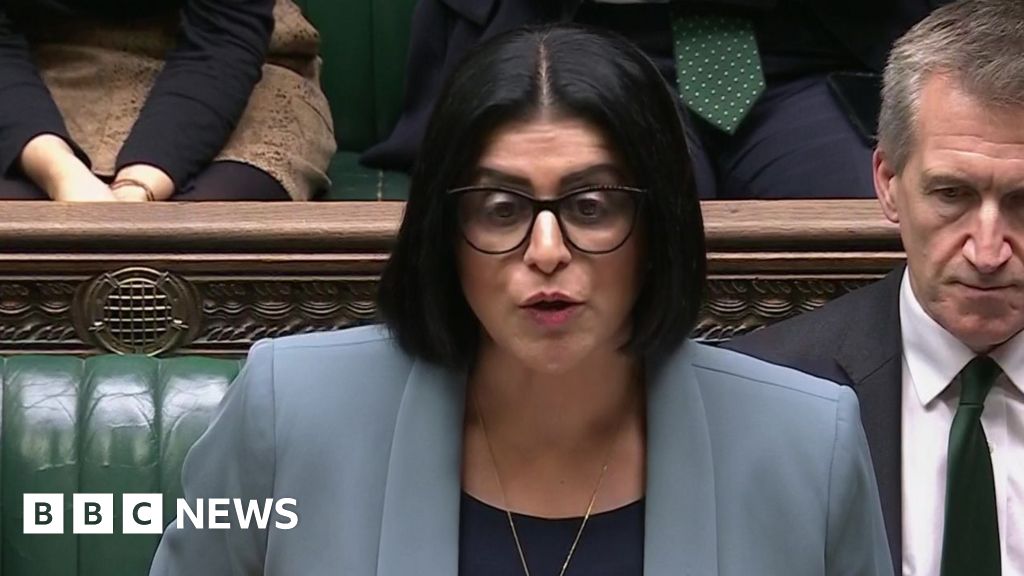
Home Secretary Shabana Mahmood unveiled sweeping asylum reforms aimed at cutting arrivals and increasing removals — including making refugee status temporary with reviews every 30 months, extending the wait for permanent residence from 5 to 20 years, ending guaranteed housing support, requiring asylum seekers with income or assets to contribute to costs, creating capped safe-and-legal routes, and signalling changes to how the ECHR and Modern Slavery Act are applied; so far this year 111,800 people have claimed asylum (39% via small boats, 37% via legal routes). The package prompted sharp cross-party debate — about 20 Labour MPs have criticised the measures as inhumane while Conservatives gave cautious support but warned the plan may fail without exiting the ECHR — and Mahmood threatened visa suspensions for Angola, DRC and Namibia to coerce deportation cooperation. For investors the proposals imply potential reductions in near-term public housing and welfare outlays but raise sizable political, legal and reputational risk (court challenges, strained international relations and NGO pushback) that could affect social housing demand, local government finances and sectors exposed to immigration policy uncertainty.
Home Secretary Shabana Mahmood has announced a wide-ranging overhaul of the UK asylum system that seeks to reduce arrivals and increase removals by making refugee status temporary (reviews every 30 months), quadrupling the wait for permanent residence from five to 20 years, ending guaranteed housing support, requiring asylum seekers with income/assets to contribute to costs, and introducing capped safe-and-legal routes. So far this year 111,800 people have claimed asylum in the UK, with 39% arriving by small boat and 37% arriving by legal routes before claiming asylum, figures the Home Office highlights to justify the measures.
The package has generated immediate political and legal risk: roughly 20 Labour MPs have criticised the proposals as inhumane, Conservatives gave cautious backing but warned the changes may fail without exiting the European Convention on Human Rights, and the government explicitly proposes changing how the ECHR and Modern Slavery Act are applied while threatening visa suspensions for Angola, DRC and Namibia. NGO commentary (Refugee Council) argues the changes will not deter arrivals, and several MPs warn of court challenges and potential U-turns given recent government backtracks on welfare cuts.
AI-powered research, real-time alerts, and portfolio analytics for institutional investors.
Request DemoOverall Sentiment
moderately negative
Sentiment Score
-0.35
Ticker Sentiment
For investors, the reforms introduce policy and execution uncertainty that could compress or reallocate demand for taxpayer-funded housing and related local-government services while creating potential legal and enforcement cost volatility. Sectors most exposed include social housing providers, local-authority financing and contractors that rely on guaranteed placements; outcomes hinge on parliamentary passage, litigation by the European Court of Human Rights, and month-to-month asylum arrival/removal statistics.
