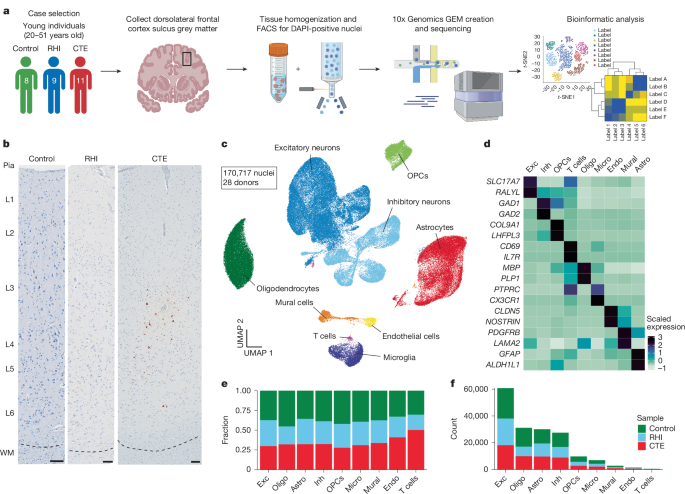
A recent study leveraging single-nucleus RNA sequencing of young individuals exposed to repetitive head impacts (RHI), primarily from contact sports, reveals significant cellular alterations and neurodegeneration occurring prior to the onset of chronic traumatic encephalopathy (CTE) pathology. Key findings include a 56% loss of specific cortical sulcus layer 2/3 neurons, inflammatory microglial responses, and angiogenic endothelial changes, all correlating with years of RHI exposure and occurring independently of p-tau deposition. This research identifies early pathogenic mechanisms and potential diagnostic biomarkers or therapeutic targets, such as the TGFβ1 signaling pathway, carrying substantial implications for the sports industry's liability, the development of early CTE interventions, and investment opportunities in neuroscience and biotech.
This study provides compelling cellular-level evidence that repetitive head impacts (RHI) from contact sports induce significant and lasting neuropathology in young individuals, even before the onset of diagnosable chronic traumatic encephalopathy (CTE). The core finding is a quantifiable, exposure-dependent loss of a specific neuronal subtype—a 56% reduction in CUX2+LAMP5+ excitatory neurons—in the cortical sulcus, a region susceptible to mechanical forces from head trauma. Crucially, this neurodegeneration is shown to occur independently of p-tau deposition, the current post-mortem hallmark of CTE. The research also details a robust multicellular inflammatory and vascular response that precedes and correlates with years of RHI exposure, characterized by the emergence of inflammatory microglial subtypes (RHIM2/3) and angiogenic endothelial cells. Furthermore, the study identifies TGFβ1 signaling as a potential mediator of microglia-endothelial cell cross-talk, offering a specific molecular pathway implicated in this early pathogenesis. These findings fundamentally shift the understanding of RHI-driven brain injury, suggesting that neurodegeneration begins much earlier than previously thought and providing a new slate of potential biomarkers for antemortem diagnosis and novel therapeutic targets that are independent of traditional CTE pathology.
AI-powered research, real-time alerts, and portfolio analytics for institutional investors.
Request DemoOverall Sentiment
strongly negative
Sentiment Score
-0.80
Ticker Sentiment
