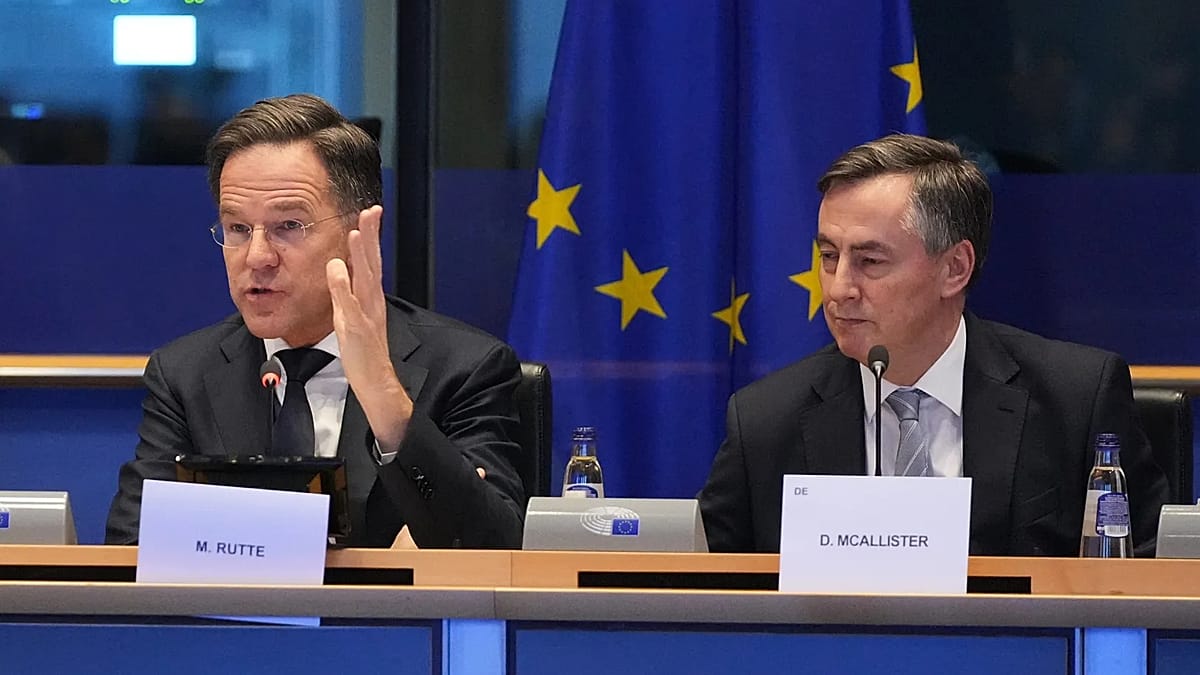
Dutch Prime Minister Mark Rutte credited U.S. President Donald Trump with forcing NATO allies to raise defence spending, saying reaching the 2% of GDP target by end-2025 — and a later 5% commitment — would not have happened without U.S. pressure. Rutte warned the EU cannot defend itself without the U.S. nuclear umbrella (arguing a unilateral European deterrent would require roughly 10% of GDP), outlined two workstreams on Arctic/Greenland security including greater NATO responsibility and direct U.S.-Denmark/Greenland talks, and urged flexibility on a €90 billion loan package to Kyiv rather than strict Europe-only procurement clauses. Implications reinforce potential sustained uplift to European and U.S. defence spending and procurement demand, while leaving near-term market impact limited and sector-specific.
Market Structure: A sustained push to 2%+ NATO defence spending by 2025 (and rhetoric toward 5%) is a structural tailwind for US primes (LMT, NOC, RTX, GD) and European defence names (BA.L, LDO.MI, SAAB-B.ST). Expect pricing power in missiles, munitions, ISR/satcom and shipbuilding; commercial aerospace (AIR.PA, BA) and fiscal-constrained EU sovereigns face budget crowding and potential demand reallocation. Supply constraints (specialty metals, military-grade semis) will support input-price inflation for suppliers over 12–36 months.
Risk Assessment: Immediate (days) sensitivity to headlines around Greenland/Arctic could spike vols and safe‑haven flows; short-term (weeks–months) risk is procurement delays, protectionist buy-Europe clauses, or budget shortfalls; long-term (years) upside if commitments turn into multi-year contracts. Tail risks: kinetic escalation in Arctic/Russia leading to commodity/shipping shocks, or EU protectionism fracturing cross-border supply chains. Hidden dependency: European capacity still needs US-sourced tech (nukes/strategic ISR), so de-coupling is costly and slow.
Trade Implications (cross-asset): Higher defence spending implies wider fiscal deficits in EU -> upward pressure on peripheral yields and weaker EUR vs USD; safe-haven bids (USD, USTs, gold) will spike on escalation. Options vols on defence names and FX will rise around NATO/EU budget votes—favour buying directional or spread structures with 3–9 month expiries to capture binary moves.
Contrarian Angles: Consensus underprices consolidation + re‑rating potential of European defence OEMs if EU allows non-EU sourcing flex (Rutte’s comment). Reaction may be underdone: market treats Trump rhetoric as noise, but concrete procurement acceleration is likelier—this favours early entry. Unintended consequence: accelerated defence capex could crowd out green/consumer capex in periphery, raising sovereign risk premiums.
AI-powered research, real-time alerts, and portfolio analytics for institutional investors.
Request DemoOverall Sentiment
neutral
Sentiment Score
0.05
