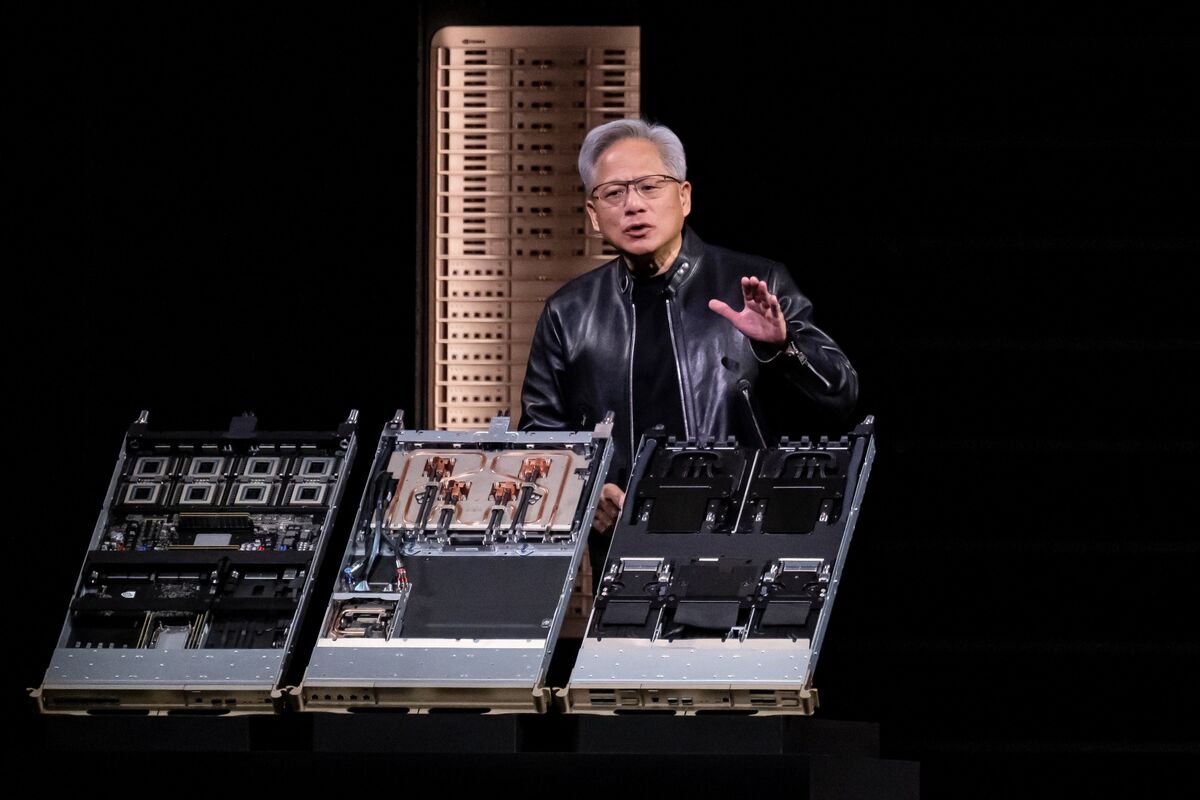
Nvidia expects to close, book and ship more than $1 trillion in AI chip business and CEO Jensen Huang said overall revenue will surpass $1 trillion as the company pushes into new markets. Huang expressed "strong confidence" in a $1 trillion-plus outcome at a San Jose investor event, a transformative revenue projection that could materially re-rate Nvidia and affect AI/semiconductor sector expectations.
Winners will extend beyond the GPU vendor to upstream capacity and packaging chains: advanced lithography (ASML) and TSMC (TSM) capture durable margin because constrained node capacity creates multi-year pricing power that raises lead times and forces customers to prepay/capacity book. Memory (Micron, MU) and high-end substrate/interposer suppliers see order volumes expand non-linearly as model sizes grow — every additional 10% in model parameter count drives ~15-25% incremental memory and interconnect spend per training cluster. Hyperscalers (AMZN, MSFT, GOOGL) face a bifurcation — either pay elevated ASPs to external vendors or accelerate internal accelerators; the latter is a 2–4 year capex/ops decision that reduces external vendor growth but raises long-term structural CPU/GPU substitution risk.
Key risks and catalysts are concentrated and time-phased: short-term (0–12 months) execution hinges on fab/ASML throughput and logistics — a single EUV tool outage or export-control tightening could push delivery schedules out 6–12 months and compress near-term revenue recognition. Medium-term (12–36 months) downside is hyperscaler insourcing and open-source software standardization eroding proprietary software lock-in, which would materially soften pricing power and justify higher R&D capex for incumbents. Macro pullbacks or inventory flushes could produce a 3–6 month demand repricing, while geopolitical export controls are low-probability/high-impact tail risks that could cut TAM in specific regions by 20–40%.
Consensus bullishness likely understates supplier upside and overstates single-name stock permanence. The market prices a lot of “Nvidia solves everything” into NVDA; cheaper leverage to the same secular demand lives in semicap and memory where multiples have more room to rerate if capex stays elevated. A preferred portfolio stance is convex exposure to the supply chain and critical infrastructure (power, cooling, interposers) while protecting against single-name execution or regulatory shocks via hedged option structures or pairs.
AI-powered research, real-time alerts, and portfolio analytics for institutional investors.
Request DemoOverall Sentiment
extremely positive
Sentiment Score
0.90
Ticker Sentiment
