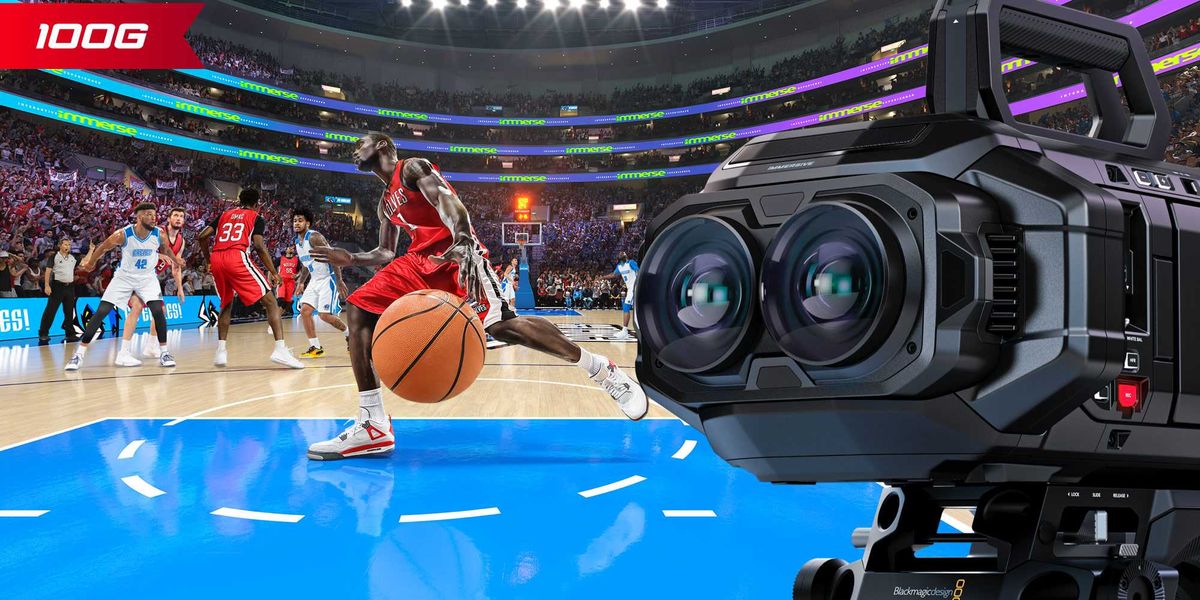
Blackmagic Design unveiled the URSA Cine Immersive 100G, the world’s first immersive cinema camera for live production, featuring dual 8Kx8K RGBW sensors, 16 stops of dynamic range, and 100G Ethernet for SMPTE-2110-22 live output. The camera is aimed at Apple Immersive Video on Apple Vision Pro and supports up to 90 fps per sensor, with pricing set at US$26,495 and availability in Q3. The announcement is positive for Blackmagic’s product portfolio but is unlikely to have a material near-term market impact.
This is less a one-off camera launch than a validation event for the entire immersive-production stack. The important second-order effect is that Blackmagic is trying to collapse the cost curve for capture, transport, and post into a single workflow, which should pressure incumbents that monetize complexity—specialty camera OEMs, proprietary live-production vendors, and high-margin middleware providers. If the workflow works at scale, the scarce resource shifts from hardware to venue integration and content rights, which is far more defensible for the ecosystem owner than for point-solution competitors. The near-term beneficiary is likely not Blackmagic equity directly, but Apple’s immersive ecosystem and adjacent production software. A lower-cost capture system expands the addressable base of studios, concert promoters, and sports rights holders that can justify experimenting with immersive formats over the next 12–24 months; that improves content supply for Vision Pro without requiring a massive step-up in device sales. The hidden risk is that adoption could remain niche if distribution economics don’t improve—content creators may love the image quality, but they still need monetization, editorial tooling, and repeatable workflows to turn this into a budget line item. For competitors, the pressure is asymmetric: premium camera vendors and live-production workflow vendors face margin compression first, while network equipment and storage providers could see incremental demand if 100G becomes the new baseline for high-end immersive rigs. Supply-chain winners are likely to be sensor, lens, and high-bandwidth infrastructure suppliers rather than the camera brand itself. The market may be underestimating how quickly a “reference design” from Blackmagic can reset pricing expectations across the category, even if unit volumes remain modest. Contrarian view: the headline is technologically impressive, but the consensus may be overestimating how fast this becomes a broad market. The adoption curve is gated by venue capex, crew training, and post-production throughput, so the financial impact is more likely to show up in 2–6 quarters than immediately. If immersive content fails to drive measurable audience engagement, this becomes a spec-sheet win rather than a demand inflection.
AI-powered research, real-time alerts, and portfolio analytics for institutional investors.
Request DemoOverall Sentiment
mildly positive
Sentiment Score
0.42
