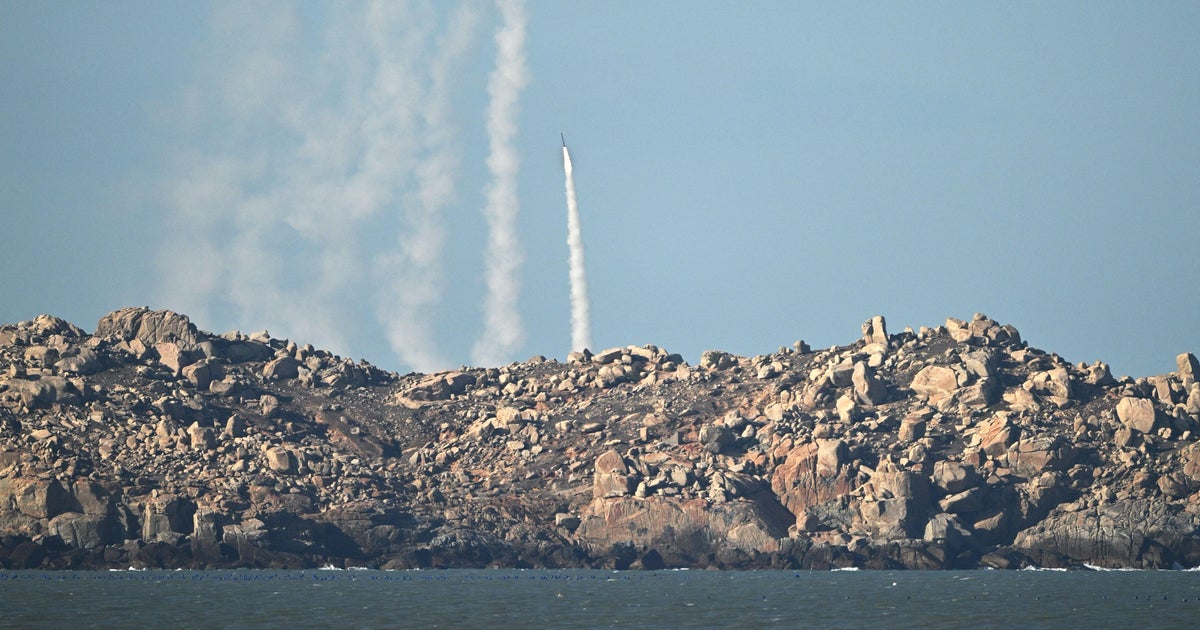
China conducted large-scale drills code-named "Justice Mission 2025," launching missiles and deploying dozens of fighter jets, navy ships and coastguard vessels to encircle Taiwan's main island, prompting Taipei to call the exercises "highly provocative" and the U.S. State Department to urge Beijing to cease military pressure. The maneuvers — the sixth major round since 2022 — follow U.S. approval of an $11 billion arms package for Taiwan and raise regional geopolitical risk, with potential implications for Asian asset risk premia and defense-related equities.
Market structure: Near-term winners are defense primes (LMT, RTX, NOC, GD) and insurers/shipping reinsurers as demand for military equipment, war-risk insurance and rerouted shipping rises; expect a 5–15% re-rating tailwind for top-5 defense names over 3–6 months if drills persist. Losers are Taiwan- and China-exposed technology firms (TSM, SMH constituents, KWEB, FXI) where a blockade risk can remove ~30–60% of advanced foundry capacity disruption risk in market pricing; expect higher risk premia and wider bid/ask spreads in Asian equities and container freight. Cross-assets: safe-haven bids (USD, JPY, gold) should strengthen immediately; USTs likely to rally (yields down 10–30bp intraday on shock), oil +2–6% on chokepoint risk, and equity vol (VIX, VXAZN) to spike 25–50% in tactical windows.
Risk assessment: Tail scenarios include a limited blockade (weeks) causing 15–30% shortfall in advanced-node supply and a full kinetic conflict with sanctions that could freeze $100s bn in trade; both would trigger forced de-risking of Asian exposures. Immediate (days) risk = 15–30% realised vol in Taiwan/China ETFs; short-term (weeks/months) = rerating of defense and energy capex; long-term (years) = structural decoupling driving sustained capex into ASML, LRCX, AMAT. Hidden dependencies: insurance availability, ports insurance surcharges, and semiconductor foundry diversification timelines (2–5 years) are the transmission mechanisms. Key catalysts: US arms sales, PLA drills escalation, Taiwan political calendar in next 30–90 days.
Trade implications: Tactical: rotate into 2–3% positions in LMT/RTX sized asymmetrically (target +10–20% in 3–6 months) while hedging with puts on Taiwan exposure (EWT/TSM). Use options: buy 90-day puts on EWT (10% OTM) as a 1–2% portfolio hedge and buy 2-month VIX call spread (0.5–1% allocation) as tail protection. Pair trades: long ASML or LRCX (1–2% for multi-year secular re-shoring) vs short SMH or EWT (1–2%) to express capex winners and regional risk simultaneously.
Contrarian angles: The market may overprice short-lived drills—if no escalation within 2–4 weeks defense multiples can mean-revert; avoid uniform conviction. Conversely, a knee-jerk -15% drop in TSM or SMH is a tactical buying opportunity for 12–36 month holdings because capacity reallocation and pricing power for advanced nodes could push margins up; consider adding TSM/ASML on >15% dislocation. Unintended consequence: rapid re-shoring benefits ASML/LRCX but will take years—don’t pay up for immediate growth; prefer duration in equipment names, tactical hedges for region-specific stress.
AI-powered research, real-time alerts, and portfolio analytics for institutional investors.
Request DemoOverall Sentiment
moderately negative
Sentiment Score
-0.35
