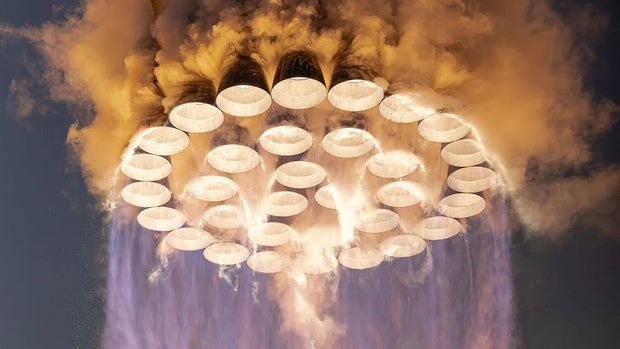
SpaceX launched its first version 3 Super Heavy-Starship test flight, featuring 33 Raptor engines, up to 18 million pounds of thrust, upgraded control systems, and a new launch pad at Starbase. The mission is an important step toward orbital missions, Starlink satellite deployment, NASA’s lunar lander program, and future Mars operations, though the booster experienced engine trouble and did not complete its target splashdown. The news is positive for SpaceX’s long-term technical roadmap but remains a developmental milestone rather than a near-term financial catalyst.
This is less a one-off test flight than a de-risking event for the entire reusable-launch stack. The first-order winner is the companies building to the cadence problem: once the vehicle is reliable enough for rapid turnaround, the bottleneck shifts from launch physics to pad uptime, thermal protection, fuel logistics, and ground handling. That tends to favor suppliers and infrastructure operators with high-mix, engineering-led work rather than pure launch competitors, because the real value accrues in repeatability and certification cycles, not the headline thrust number.
The bigger second-order implication is on launch supply elasticity. If SpaceX proves it can close the loop on orbital refueling and higher payload classes over the next 6-12 months, it compresses the economics of heavy government and commercial launches and puts pressure on legacy providers that rely on scarcity premiums. That is negative for any incumbent whose moat is mission assurance alone, but positive for adjacent names exposed to higher satellite counts, higher launch frequency, and ground-network utilization.
The contrarian read is that the market may be over-indexing on the moon/Mars narrative and underpricing the operational drag. The most important failure mode here is not a dramatic explosion; it is a series of partial successes that still leave the system years away from routine orbital operations. Any slip in pad reliability, engine reuse, or propellant transfer would push revenue recognition and NASA milestone timing to the right, which matters because these programs are priced on confidence in a 2027-2028 cadence, not on eventual success.
For ORN specifically, the data suggests no direct earnings beta today, but the theme is that large-scale aerospace infrastructure spending remains supported. The tradeable angle is in the ecosystem: the nearer-term winners are specialty industrials and comms-network names exposed to satellite launch volume, while the main risk is that investors extrapolate this test into near-term cash flow too aggressively and get disappointed by the long certification runway.
AI-powered research, real-time alerts, and portfolio analytics for institutional investors.
Request DemoOverall Sentiment
mildly positive
Sentiment Score
0.20
Ticker Sentiment
