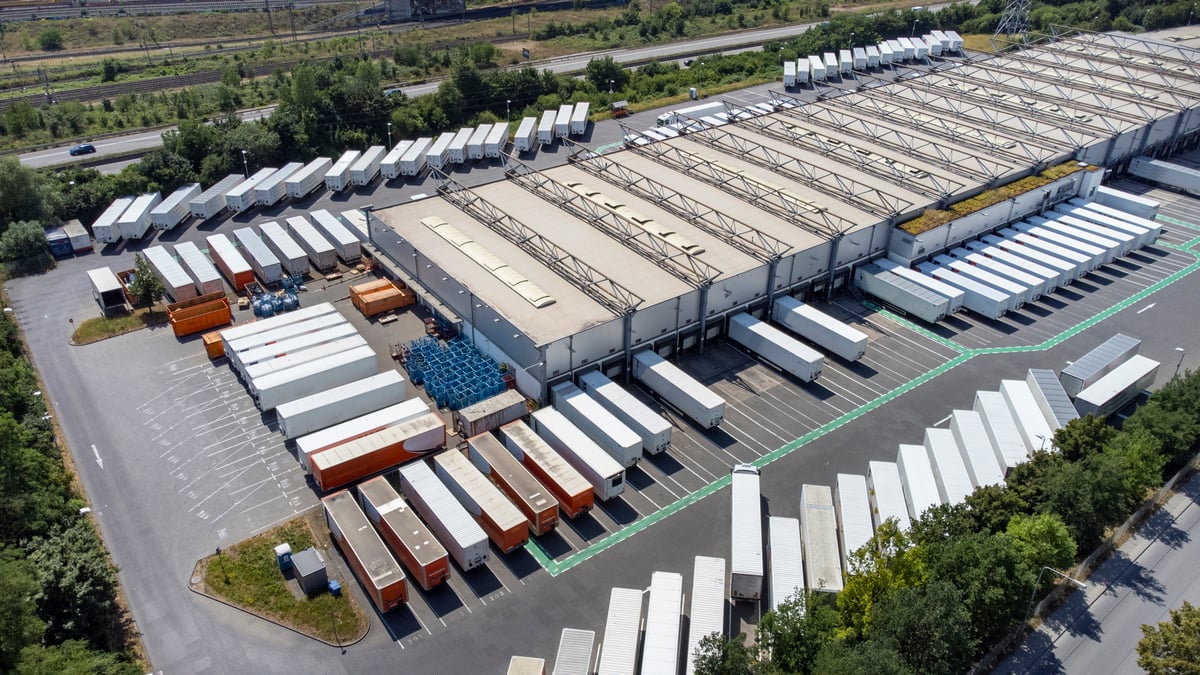
UPS is in the early stages of a multiyear operational overhaul (announced January 2025, running through 2027) to shift capacity away from low‑margin, high‑volume e‑commerce (notably Amazon) toward higher‑margin small‑business shipping, logistics and premium international services; in Q3 Amazon volume fell 21%, 93 buildings have been closed and U.S. revenue per piece rose 9.8%. The market has punished near‑term results—shares are down about 25% year‑to‑date and roughly 60% from the February 2022 peak despite a 12% bounce since the Q3 report—while the dividend yield has jumped to about 7% with a roughly 98% payout ratio, a potential risk if turnaround execution falters; analysts model EPS growth of ~4% in 2026 and ~11% in 2027 assuming the plan succeeds.
UPS is executing a multiyear operational overhaul announced in January 2025 and targeted to run through 2027, and the company says it is roughly one-third of the way through this transformation. The strategy explicitly shifts capacity away from high-volume, low-margin e-commerce (notably Amazon) toward small-business shipping, logistics and premium international services; in Q3 Amazon volume was down 21% year-over-year and 93 buildings were closed as part of cost reductions.
Operationally the repositioning produced a 9.8% increase in U.S. revenue per piece in Q3, but the market has punished near-term disruption: shares fell to a five-year low, are down ~25% year-to-date and roughly 60% below the February 2022 peak despite a 12% bounce after Q3 results, and external sentiment is mixed with a moderate market-impact signal. This divergence reflects investor skepticism that short-term pain will translate into sustainable margin improvement.
Capital return dynamics amplify the risk-reward trade-off: the share-price decline has pushed the dividend yield to about 7% with an estimated payout ratio near 98%, even as UPS reiterates its commitment to maintain or grow the dividend (paid or raised each year since 1999). Analysts model EPS growth of ~4% in 2026 and ~11% in 2027 assuming successful execution, so dividend sustainability and upside depend materially on execution of the network remake and consequent margin and free-cash-flow recovery.
AI-powered research, real-time alerts, and portfolio analytics for institutional investors.
Request DemoOverall Sentiment
mixed
Sentiment Score
-0.10
Ticker Sentiment
