
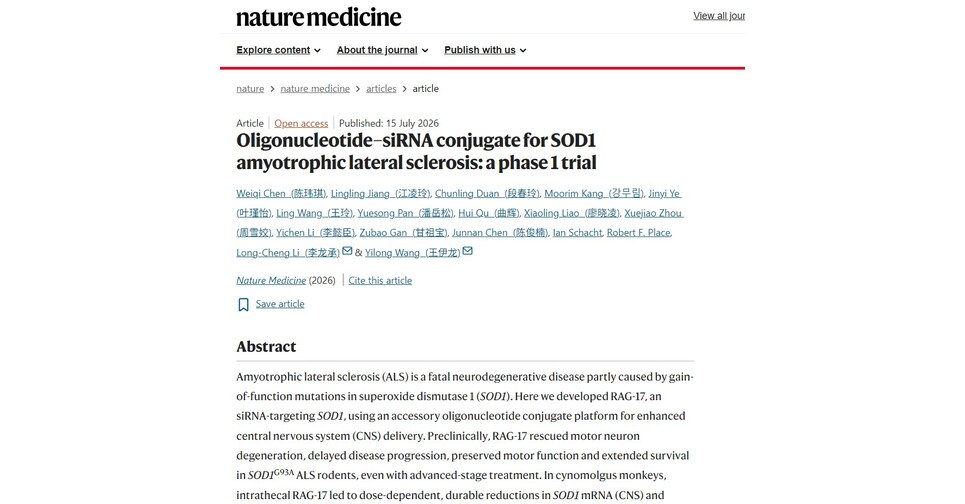
Ractigen Therapeutics published Nature Medicine data for RAG-17 (SOD1-ALS), reporting first-in-human safety with no Serious Adverse Events (SAEs) in a 6-patient dose-escalation study. Biomarkers showed mean CSF SOD1 protein down 69% at Day 240 and plasma NfL down 62% (with individual nadirs to 85% below baseline). Preclinical models also showed late-stage rescue in mice with survival extended by up to 75.8% (128.5 days) and up to 91% SOD1 mRNA reduction in NHP spinal cord lasting up to 72 days, supporting less frequent dosing potential.
This is more important as a platform-validation event than as a near-term revenue event. The market mechanism is the re-rating of CNS RNA delivery credibility: if intrathecal oligo conjugates can show durable target knockdown with a tolerable profile, it lowers the perceived technical risk for the whole CNS RNAi stack and raises the option value of companies that own delivery IP. The direct commercial pool in SOD1-ALS is too small to matter for large caps, but the read-through can still move sentiment in RNA names if investors start extrapolating beyond one ultra-rare indication.
The main winner set is not the incumbent ALS franchise but platform owners with broader CNS ambitions, especially Ionis (IONS) and, to a lesser extent, Alnylam (ALNY) and Arrowhead (ARWR) on any positive modality spillover. The loser is any company whose thesis depends on repeated invasive dosing or modest biomarker effect sizes; if a durable intrathecal approach proves real, the market will penalize less-differentiated programs on convenience and potency. That said, the second-order effect is probably more on partner economics and licensing leverage than on reported sales, because payors and physicians will still wait for functional slope data, not just biomarkers.
Time horizon matters: over the next days, this is mostly a headline catalyst for biotech quant screens and Chinese clinical-stage names, with limited fundamental impact. Over 1-3 months, the key catalyst is whether the company can present larger, more disciplined phase 2 data or attract a credible ex-China partner; without that, the move fades. Over 6-18 months, the falsifier is simple: if ALS functional endpoints do not separate from historical noise, the Nature Medicine imprimatur will not prevent multiple compression in the broader oligo-delivery basket.
Contrarian view: the consensus will likely overweight the biomarker delta and underweight n=6 fragility, open-label bias, and the gap between protein knockdown and clinically meaningful survival. The right read is not "best-in-class already won," but "delivery risk got cheaper." That is constructive for the platform complex, but not yet enough to justify aggressive longs in a large-cap biotech index.
AI-powered research, real-time alerts, and portfolio analytics for institutional investors.
Request TrialOverall Sentiment
strongly positive
Sentiment Score
0.70
Ticker Sentiment
