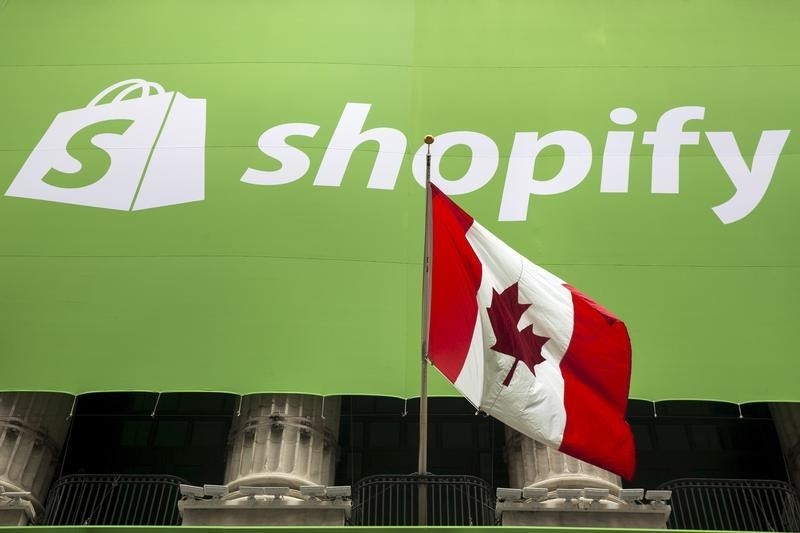
Shopify reported Q1 2026 revenue of $3.2B, beating the $3.09B consensus, with gross merchandise volume up 35% year over year to $100.7B and GAAP operating margin expanding 345 bps to 12.1%. Management guided Q2 2026 revenue growth in the 'high 20s,' slightly above the 26.9% consensus, though investors remain focused on rising expenses and AI-related spending. The article also highlights mixed analyst reactions, including price target cuts from Citizens, DA Davidson, and Jefferies despite continued positive ratings from several firms.
The key takeaway is not just that one commerce platform is compounding well, but that AI-led capex is becoming a monetization race across the software stack. Shopify’s strength validates that merchants are still spending, which is supportive for payment rails, fulfillment tech, and ad-tech that sit downstream of GMV; the second-order winner is anyone monetizing seller productivity rather than just traffic. The flip side is that investors are beginning to reward “quality growth” less for top-line surprise and more for proof that incremental spend translates into durable operating leverage, which keeps the bar high for every software name with AI spend but no margin inflection.
For AMD, the read-through is more important than the headline move: a 17% gap-up in response to AI data-center demand suggests the market is repricing from “units story” to “capacity constraint story.” If hyperscaler and enterprise demand is broadening, the next leg benefits not only accelerators but also adjacent suppliers in networking, power, and thermal management; however, it also raises the risk that expectations get pulled forward by 6-12 months, leaving the stock vulnerable if backlog conversion or supply normalization slows. The market is effectively saying that inference demand, not just training, is now credible enough to justify multiple expansion.
The contrarian issue is valuation compression risk disguised by good numbers. When the market starts upgrading across the board, dispersion usually narrows in the short run, but that creates a better setup for pairs: long the name with visible operating leverage and short the name where AI spending is still being subsidized by marketing or payroll discipline. Over the next 1-3 months, the main reversal catalyst is not demand disappointment but margin scrutiny — if investors start quantifying customer acquisition payback or AI monetization lag, high-multiple software can de-rate quickly even while revenue remains strong.
AI-powered research, real-time alerts, and portfolio analytics for institutional investors.
Request DemoOverall Sentiment
mildly positive
Sentiment Score
0.35
Ticker Sentiment
