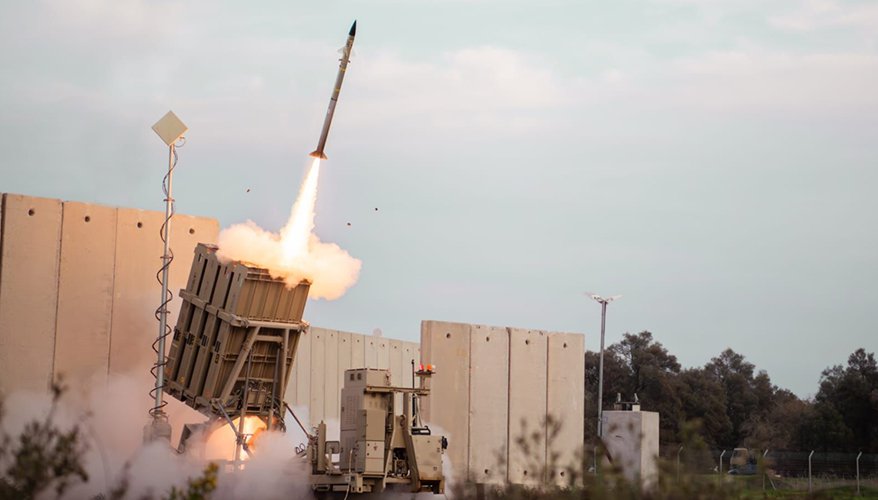
Recent Middle East operations show defending against drone and missile strikes is materially harder than offense: former Israeli national security advisor Eyal Hulata says existing high-end interceptors (Iron Dome, David’s Sling, Arrow) are ill-suited and uneconomical against cheap drones and swarms. Hulata warns solutions are needed within roughly 6–24 months and advocates using AI for detection, accelerated R&D, and multinational joint command-and-control and tech development. Implication for portfolios: expect near-term increased demand for low-cost counter-drone systems, sensors, AI-enabled detection, and defense R&D partnerships across allied nations.
Operational feedback from recent engagements will force procurement and engineering timelines to compress: expect prototype-to-field cycles measured in months, not years, and an urgent premium on modular, COTS-based subsystems that can be iterated in the field. That tilts demand toward edge-AI compute, high-power RF/GaN components, and rapid-turn sensing (EO/IR/LIDAR) suppliers rather than big-ticket, long-lead missile programs, creating a multi-year re-weighting of defense supply chains.
Second-order winners are likely to be small, specialist vendors with repeatable manufacturing and DoD bridge contracts because primes will prefer bolt-on acquisitions to build capability quickly; anticipate a wave of M&A in 6–18 months as incumbents buy proven tech rather than fund risky internal programs. Geopolitically, coalition procurement packages will centralize volume (faster contracts but concentrated price pressure), which benefits suppliers who can scale production geopolitically (US allies, TAA-compliant fabs) and hurts vendors dependent on single-country sales.
Key risks are asymmetric: a software/AI false-positive cascade or a high-profile field failure could freeze purchases for quarters, while a genuine technical leap in power-dense directed-energy or battery technology would re-route demand away from kinetic/electronic solutions. Monitoring triggers — urgent buys, multinational RFPs, export-control announcements, and demonstrable field trials within 3–12 months — provides the clearest near-term read on which firms capture follow-on orders.
AI-powered research, real-time alerts, and portfolio analytics for institutional investors.
Request DemoOverall Sentiment
neutral
Sentiment Score
0.00
