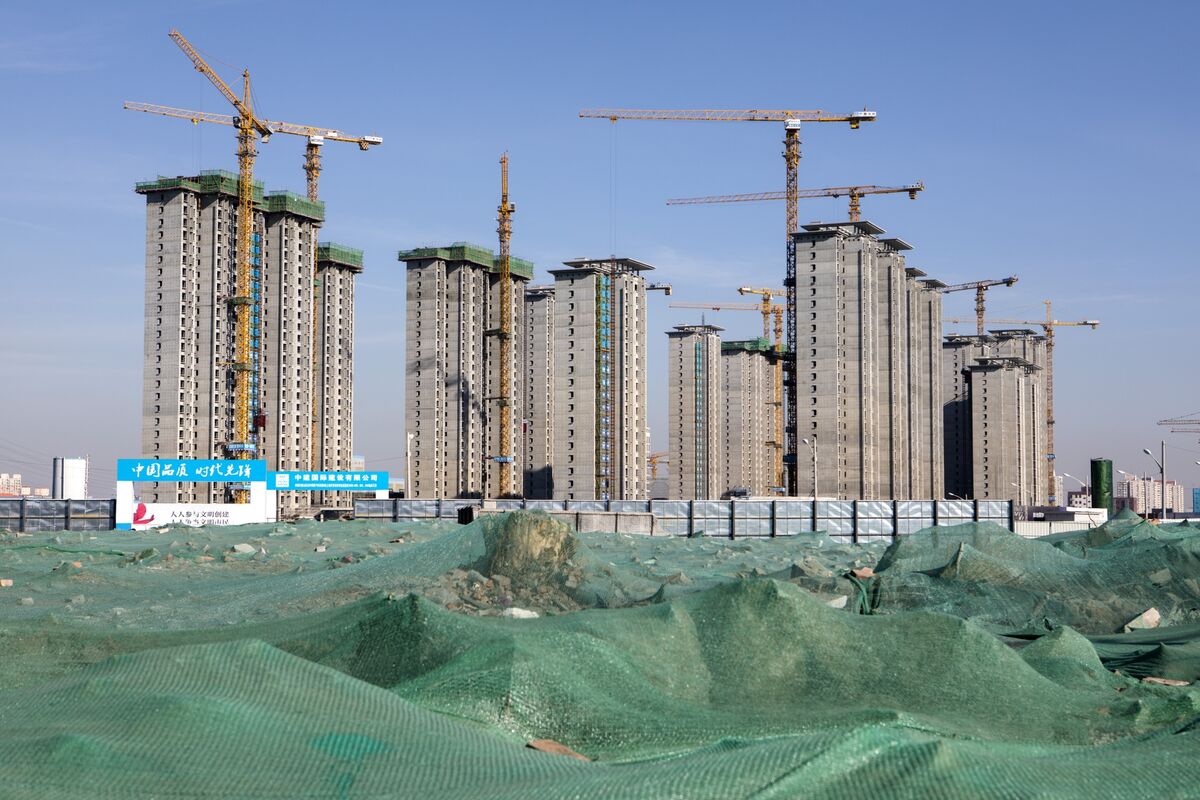
State-backed China Vanke's credit stress intensified as its onshore bonds plunged this week, with a 566 million yuan bond due May 2028 falling about 19 yuan to 75 yuan and triggering a brief trading halt. The selloff underscores investor concern that Vanke may struggle to avoid default in coming months absent clearer government support, amplifying downside risk for China’s broader property sector and credit-sensitive markets.
Market structure: The Vanke bond plunge (≈-20% on a May‑2028 note) reprices credit risk across China property — losers are mid/smaller private developers with >200–500bp spread widening; winners are state-linked builders and holders of high‑quality Chinese sovereign paper who benefit from safe‑haven flows. Competitive dynamics will favor developers with explicit SOE links (likely to access emergency liquidity), pressuring private names’ pricing power on new land purchases and presales, compressing their liquidity lifelines over 3–12 months. Cross‑asset: expect EM credit spreads to widen 50–150bps, HK/China real‑estate equity vol to spike 30–80% relative to index, downward pressure on iron‑ore/cement demand (−5–15% risk), and near‑term CNY depreciation of ~1–3% if capital flight intensifies.
Risk assessment: Tail risks include a systemic local‑bank liquidity squeeze (contagion to tier‑2 banks) or clustered defaults causing a 10–30% decline in major city home prices over 6–12 months; regulatory tail such as enforced nationwide debt restructuring could trigger cross‑defaults. Immediate (days): continued illiquidity and headline risk; short term (weeks–months): potential targeted state support announcements; long term (quarters–years): secular demand shock if household confidence and presales remain impaired. Hidden dependencies: developer cashflows hinge on presales and LGFV land‑sales — both are volatile and can flip solvency fast.
Trade implications: Short selectively: small/mid private developers (e.g., Country Garden 2007.HK, Sunac 1918.HK) via equity shorts or CDS where available, target position size 1–3% portfolio, time horizon 3–6 months; hedge with long state‑linked names (China Resources Land 1109.HK) to capture flight‑to‑quality. Buy protection: 3‑6 month put spreads on 2007.HK (−15%/−30%) to limit premium outlay while targeting >20% downside. Allocate 2–4% to onshore 10y China government bonds or CGB futures as a defensive asset and open a 1–2% USD/CNH long via forwards if CNY weakens >1%.
Contrarian angles: The market may be overpricing guaranteed default for systemically important Vanke — Beijing historically steps in for large spillovers within 30–90 days; that creates an asymmetric opportunity to buy deeply discounted paper if a credible backstop appears. Conversely, if support focuses only on selected SOEs, private developers will face permanent market share loss — meaning any long of private names requires strict trigger‑based entries (e.g., presales recovery >10% MoM). Historical parallel: 2014–2016 episodic support led to quick snapbacks in systemically important issuers, so consider small, conditional long positions in Vanke H/A (2202.HK / 000002.SZ) with tight 10% stop if no policy clarity in 60 days.
AI-powered research, real-time alerts, and portfolio analytics for institutional investors.
Request DemoOverall Sentiment
strongly negative
Sentiment Score
-0.70
