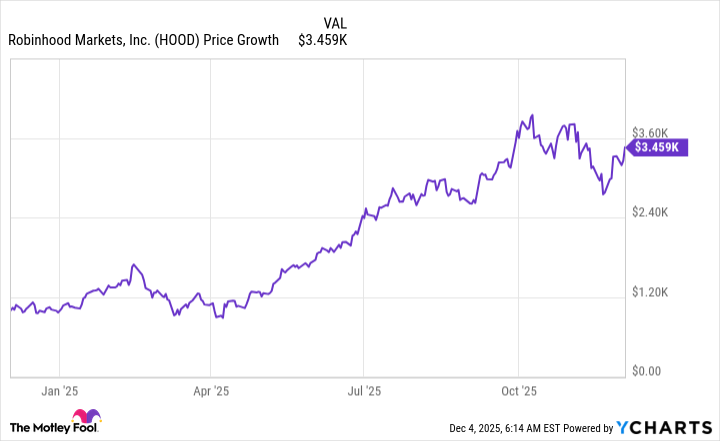
Robinhood has delivered a rapid turnaround with Q3 revenue rising 100% YoY to $1.27 billion and net income surging 271% to $556 million (after a Q3 2023 loss of $85 million), helping drive a roughly 246% stock gain over the past year through Dec. 3. The company remains focused on its retail trading platform while diversifying into crypto (Bitstamp) and prediction markets (subject to legal pushback), signaling stronger fundamentals and improved profitability that could support continued investor interest.
Market structure: Robinhood's Q3 ($1.27bn revenue, net income $556m) signals a transition from growth burn to cash-generative fintech, shifting wallet share toward platform-native products (crypto, subscriptions, margin). Immediate winners are digital-first brokers and crypto venues (Bitstamp expands custody revenue); losers are incumbents with higher fees and slower UX (price-sensitive retail segments at SCHW, IBKR may see share pressure). Higher retail activity also raises demand for short-dated equity options and increases implied volatility skew in small caps over the next 3–12 months.
Risk assessment: Tail risks center on regulatory/legal shocks (SEC action on prediction markets or PFOF reforms), large-scale crypto drawdowns, or platform outages — any of which could trigger >20% stock repricing within days. Short-term (days–months) momentum could persist; medium-term (3–12 months) depends on DAU and crypto volumes; long-term (12–36 months) hinges on diversification execution and fee economics. Hidden dependencies include Payment-for-Order-Flow, interest rate sensitivity of net interest income, and crypto custody margins; catalysts include Q4 user metrics, SEC rulings (30–90 days), and crypto market direction.
Trade implications: Tactical: establish a 2–3% long position in HOOD using 9–12 month call spreads to limit premium risk, size to target 30–50% upside over 6–12 months; trim if DAUs fall >10% QoQ or guidance misses rev by >5%. Relative: pair trade long HOOD (2%) / short SCHW (1.5%) to express retail-share shift while hedging market beta. Volatility: sell 1–3 month OTM covered calls on newly acquired HOOD stock if IV > realized vol by >20% to harvest premium; alternatively buy a protective 6–9 month put if exposure >3%.
Contrarian angle: The market likely underprices regulatory/legal tail risk and overweights short-term margin expansion; a precedent is E*TRADE’s commoditization after user growth peaked. If prediction-market litigation or crypto regulation escalates, expect a swift 15–30% de-rating; conversely, failure to account for sustained DAU monetization would mean current pessimism is overdone and HOOD could outperform for 12–36 months.
AI-powered research, real-time alerts, and portfolio analytics for institutional investors.
Request DemoOverall Sentiment
moderately positive
Sentiment Score
0.60
Ticker Sentiment
