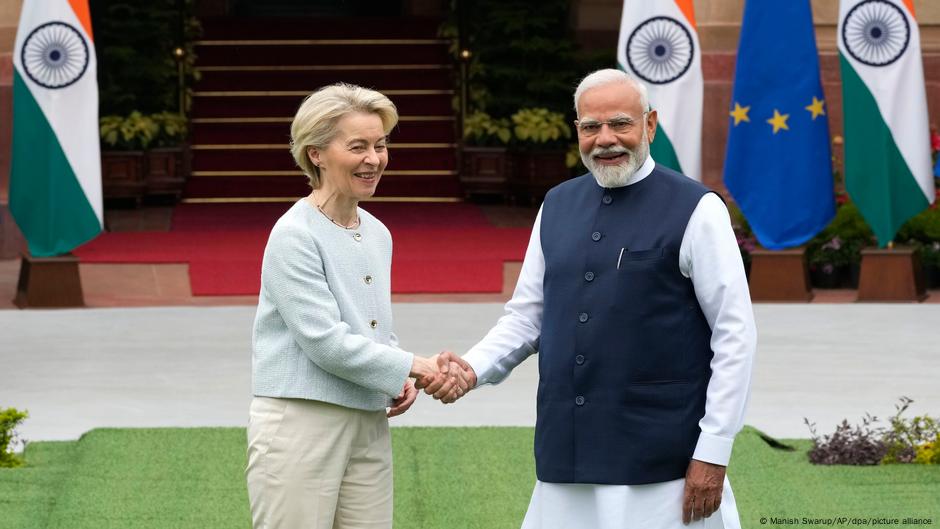
India and the EU are rapidly progressing towards finalizing a Free Trade Agreement (FTA) by year-end, a move significantly accelerated by the unpredictability and substantial tariffs imposed by the US under President Trump on Indian exports. This strategic partnership aims to provide India with stable export markets, reducing its reliance on volatile US trade, while enabling the EU to diversify supply chains, secure key trade sectors, and enhance its geopolitical influence. Despite strong political will, negotiations still face challenges, particularly concerning tariff reductions on sensitive goods and the EU's Carbon Border Adjustment Mechanism (CBAM), yet the successful conclusion of this deal would mitigate geopolitical risks and establish a robust trade relationship between two major global economies.
Geopolitical pressure, primarily from US protectionist tariffs, is accelerating Free Trade Agreement (FTA) negotiations between India and the European Union, with both parties targeting a year-end conclusion. The US has imposed tariffs of up to 50% on Indian goods, impacting a potential $43.5 billion of India's exports and creating a strong incentive for India to secure stable, tariff-free access to the EU for key sectors like textiles, pharmaceuticals, and steel. For the EU, which is India's second-largest trading partner with €120 billion in goods trade last year, the agreement offers a strategic opportunity to diversify supply chains, enhance its presence in the Indo-Pacific, and gain access to India's large and predictable market. Despite high-level political engagement and a clear sense of urgency, significant hurdles remain. Key sticking points include the EU's Carbon Border Adjustment Mechanism (CBAM), which poses a threat to Indian heavy industry, and conflicting demands for market access, with the EU seeking lower tariffs on vehicles and spirits while India pushes for its own key exports. A potential breakthrough in the automotive sector, granting European manufacturers greater access to India in exchange for Indian auto parts access to the EU, signals that the strategic imperative to finalize the deal may overcome long-standing negotiation challenges.
AI-powered research, real-time alerts, and portfolio analytics for institutional investors.
Overall Sentiment
strongly positive
Sentiment Score
0.65
