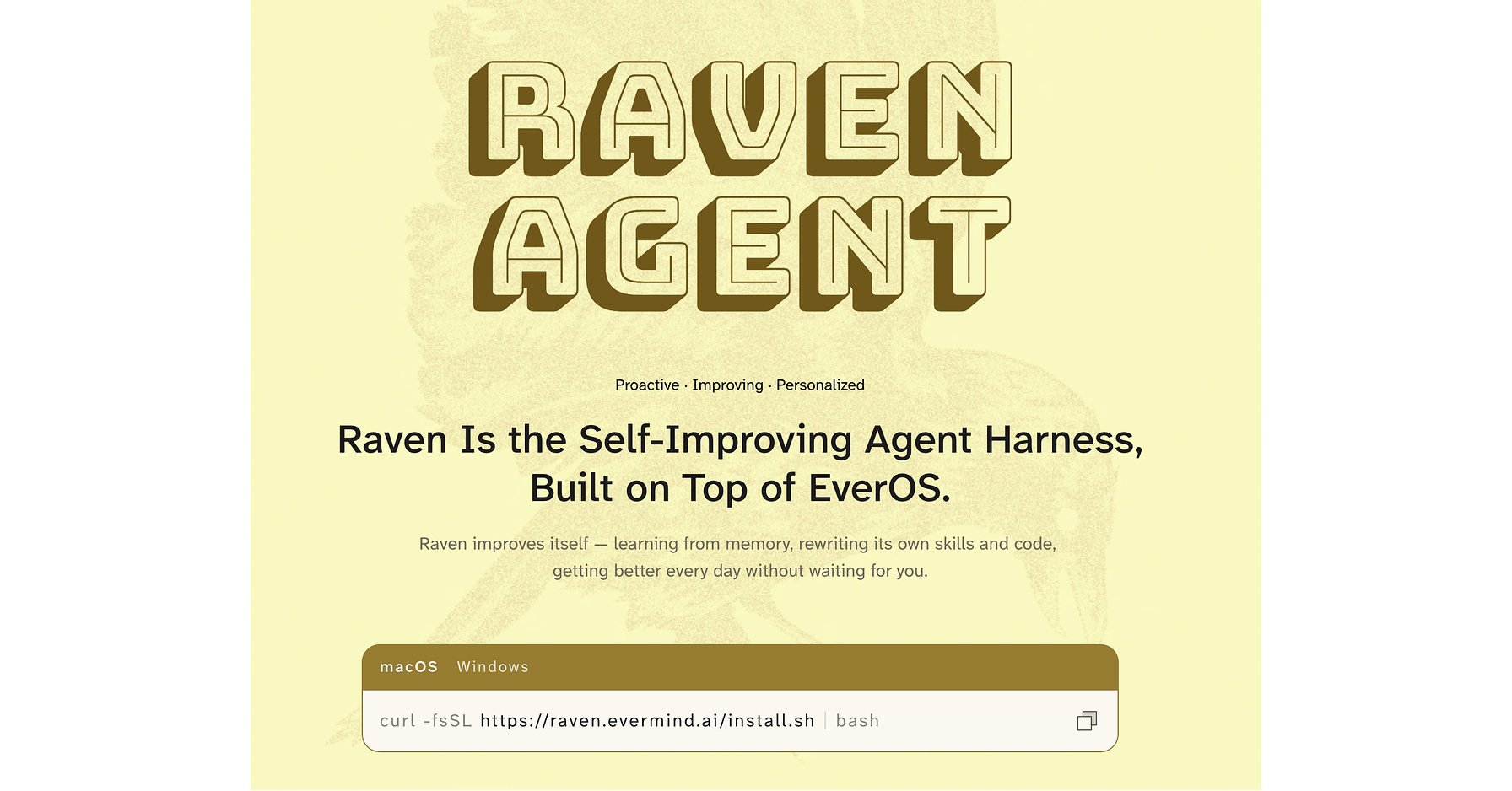
EverMind launched Raven Agent, a “self-rewriting” L3-level agent harness built on its open-source EverOS memory operating system, positioning it to internalize user preferences rather than rely on stateless retrieval. Raven ships with 100,000 continuously evaluated skills and claims code-level self-improvement (including runtime logic/strategy rewriting) potentially enabled by on-device EverBrain fine-tuning when users are offline. EverOS 1.1.0 highlights a new memory taxonomy and a proprietary Reflection mechanism; the firm also cites new research results (e.g., MSA up to 100M tokens, HyperMem 92.73% SOTA). Overall, the news is positive for AI infrastructure progress, but it’s more product/research oriented than clearly tied to near-term financial impact.
This is more meaningful as a signaling event than a near-term P&L event. The economic center of gravity in agentic AI is shifting from model quality to control planes for memory, orchestration, and governance; that favors infrastructure vendors with distribution into enterprise workflows, while pure-play “agent” vendors without usage-based revenue risk being valued on narrative rather than cash flow. Open-source traction can accelerate adoption, but it also compresses the moat unless there is a clear proprietary data loop or embedded distribution.
The second-order winner set likely includes hyperscalers and security vendors more than niche AI apps. Persistent, self-improving agents increase the need for identity, auditability, sandboxing, and policy enforcement, which should expand budget share for MSFT, CRWD, and PANW over time; by contrast, any vendor whose value proposition is mostly retrieval, indexing, or wrapper logic risks being commoditized if memory becomes a standard layer. A subtle counterpoint: if the system becomes more efficient at retaining context, token consumption per task may fall, which would temper the bullish case for pure inference-volume beneficiaries like NVDA in the very near term.
The contrarian miss is that “self-rewriting” can be a sales negative before it is a product positive. Enterprises usually adopt autonomy last, not first, so the initial adoption curve is likely to be gated by security reviews and human-in-the-loop requirements; that pushes the monetization timeline into months, not days. What would falsify the bullish infrastructure read-through is evidence that developer interest does not convert into paid API usage, or that enterprises cap these agents in locked-down environments and the product remains a demo rather than a deployment.
AI-powered research, real-time alerts, and portfolio analytics for institutional investors.
Request DemoOverall Sentiment
moderately positive
Sentiment Score
0.35
Ticker Sentiment
