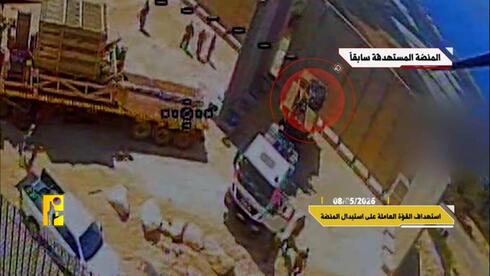
Israel is deploying thousands of meters of fishing nets to southern Lebanon units after Hezbollah released footage showing FPV drones striking an Iron Dome battery, highlighting a growing battlefield vulnerability. The IDF said it struck 70 Hezbollah targets in the past 24 hours and more than 800 since the ceasefire began, while Hezbollah continues to fire drones, rockets and anti-tank missiles toward northern Israel. The article underscores persistent escalation risk in the north and the difficulty of countering cheap, precise drones despite Iron Dome protection.
The key market read is not just tactical battlefield improvisation; it is the proof that low-cost drones are forcing an expensive reallocation of defense budgets toward point-defense, EW, sensors, and passive protection. That tends to benefit the picks-and-shovels layer—counter-UAS detection, RF jamming, C2 software, and hardened infrastructure—more than legacy air-defense primes, because the drone problem is too distributed and too cheap to solve with interceptors alone.
Second-order, the fishing-net response is a signal that frontline users are optimizing for survival, not elegant technology. That usually accelerates procurement of layered, modular defenses in 3-12 months, but it also exposes a near-term gap: armies can’t scale a bespoke answer fast enough, which increases demand for consumables, retrofit kits, and rapidly deployable systems. The loser set is any platform or battery that relies on a single high-value emitter or fixed geometry; these become increasingly vulnerable to saturation and cheap reconnaissance.
The contrarian point is that the headline is bearish for kinetic-defense suppliers in the very short term but bullish for them over the medium term, because visible defeats force larger budgets and faster fielding cycles. The consensus may underappreciate how quickly this shifts procurement from “nice-to-have” to emergency spending, especially as similar threats migrate from one theater to another. If escalation broadens, the relevant trade is not pure drone manufacturers alone, but the full stack of air-defense modernization and base-protection systems.
For equities, the cleaner expression is to favor companies with exposure to counter-UAS, electronic warfare, secure comms, and battlefield sensors rather than pure-play drone OEMs, which are easier to commoditize. In the public market, that points more toward diversified defense names with C-UAS content than small-cap UAV beta, because the budget flows should arrive first through large integrators and only later through niche suppliers.
AI-powered research, real-time alerts, and portfolio analytics for institutional investors.
Request DemoOverall Sentiment
moderately negative
Sentiment Score
-0.35
Ticker Sentiment
