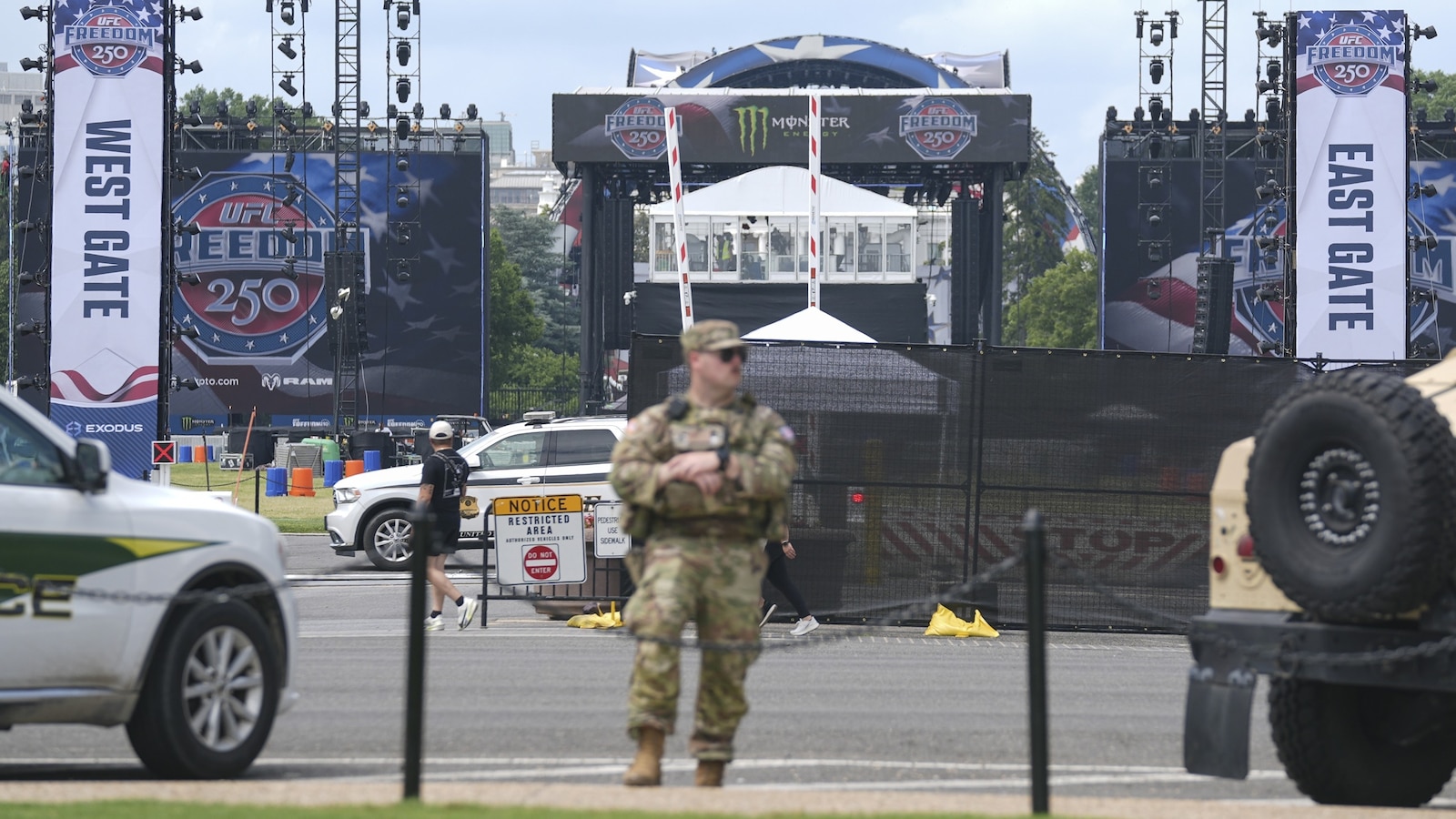
Secret Service says UFC Freedom 250 at the White House will face Super Bowl-level security, with invitation-only access for roughly 4,000 guests on the South Lawn and TSA-like screening for ticketed fans on The Ellipse. The agency also said the July 4 fireworks on the National Mall will be treated as a National Special Security Event, with designated screening points and restrictions on drones and bags. The article is primarily a public safety and event-security update, with limited direct market impact.
This is a short-duration demand shock for a very specific bucket: urban event operations. The immediate beneficiaries are private security contractors, credentialing/access-control vendors, temporary fencing/barrier providers, and high-end hospitality near the Mall/Capitol corridor; the losers are lower-end walk-up concessions and any operator relying on impulsive foot traffic, because the conversion rate on casual attendance falls sharply when entry friction rises.
The bigger second-order effect is reputational: once the public experiences ‘airport-style’ screening for a civic event, organizers across D.C. will import the same playbook for the next 6-12 months. That raises the baseline cost structure for large outdoor gatherings, which is modestly bullish for firms that sell screening, perimeter management, and crowd analytics, but bearish for event organizers whose margin model assumes loose access and high-throughput arrival windows.
The tail risk is not attendance collapse but queue failure. A few hundred bps of incremental screening delay can turn a free event into a negative-experience headline, amplifying last-minute no-shows and forcing sponsor/community optics damage. The contrarian angle is that enhanced security may actually improve premium-event pricing power over time: if access gets harder, RSVP systems and paid VIP tiers become more valuable, and that favors operators that can monetize certainty rather than volume.
I would treat this as a tactical, not structural, thesis unless the July 4th mall event also runs cleanly under the new model. If security incidents occur, the policy shift hardens and the revenue opportunity for security vendors extends beyond the summer calendar; if the events are smooth, the incremental spending likely normalizes after a few weeks.
AI-powered research, real-time alerts, and portfolio analytics for institutional investors.
Request DemoOverall Sentiment
neutral
Sentiment Score
0.00
