


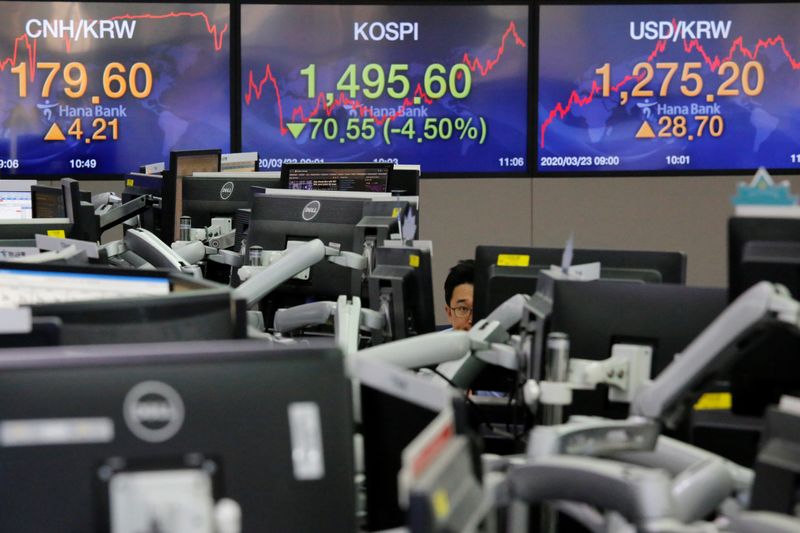
KB Securities sees South Korea’s KOSPI reaching 7,500 by end-2026, driven by semiconductor earnings growth and a broad re-rating of Korean equities. It projects KOSPI operating profit of 792 trillion won in 2026, up 165%, rising to 1.04 quadrillion won in 2027, with Samsung Electronics and SK hynix leading the move. The outlook also points to stronger foreign inflows, a firmer won, and potentially improved bond-market dynamics as corporate tax revenues rise sharply.
This is less a one-country valuation story than a global capital-allocation story centered on a shift in memory semis from cyclical commodity exposure toward quasi-contracted supply. If the market starts to price Korean memory like a capacity-constrained, order-driven franchise rather than a spot-price lever, the multiple expansion could outrun the earnings revision itself because duration extends and downside volatility compresses. That re-rating would also spill into Korea’s broader risk premium: higher retained earnings, stronger tax intake, and larger FX inflows all mechanically improve sovereign funding optics and should narrow the discount rate applied to the entire market.
The second-order winner is not just the big Korean incumbents, but any equipment, materials, and downstream firms tied to new fabs and cluster buildouts; the market will likely underappreciate how quickly this can propagate into construction, power infrastructure, and industrial automation. On the other side, Taiwan’s pure-play foundry ecosystem may face a relative-multiple headwind if investors conclude memory is converging toward similar process discipline without needing the same capex intensity. Global semiconductor leaders like NVDA are not directly threatened on fundamentals, but their scarcity premium could be capped if foreign capital rotates toward cheaper operating leverage in Korea.
The main risk is timing: this is a 6-18 month re-rating setup, not a next-week trade. It can fail if memory pricing rolls over before contract structure tightens, if geopolitical risk re-escalates enough to keep foreigners sidelined, or if the won strengthens too quickly and blunts the earnings translation for exporters. The consensus may be underestimating how much of the upside is already reflected in earnings revisions, but still missing that the real catalyst is capital flow normalization, which can persist long after the first earnings inflection.
For U.S. investors, the cleanest expression is to own the Korea beta through a basket rather than trying to pick the exact winner, because the key driver is a market-wide discount-rate compression. The best risk/reward is likely in pairing long Korean semis versus a high-multiple semiconductor proxy, since the trade isolates re-rating from broader tech beta. If the story is right, the first move should be foreign inflows and multiple expansion; if it is wrong, the market should revert quickly because the valuation support remains cheap but not catalyst-free.
AI-powered research, real-time alerts, and portfolio analytics for institutional investors.
Request TrialOverall Sentiment
moderately positive
Sentiment Score
0.70
Ticker Sentiment
