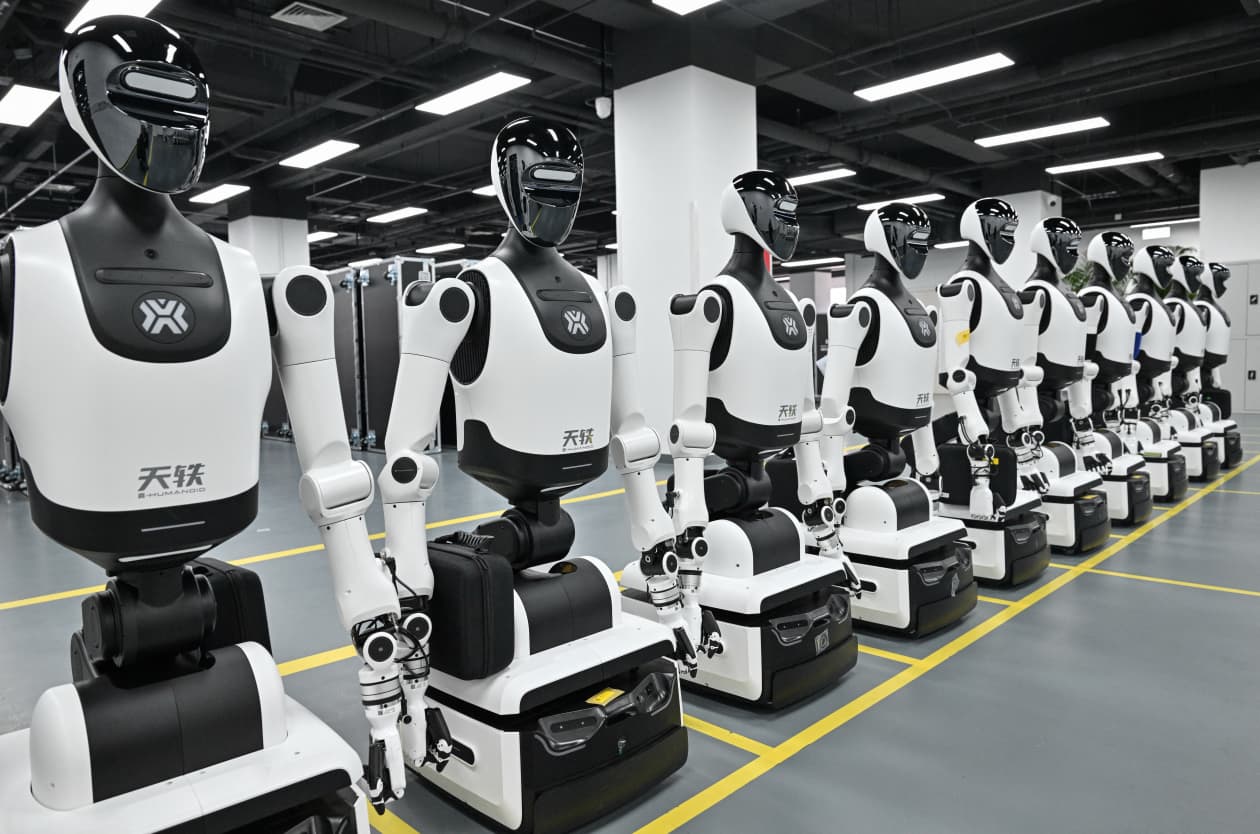
China is funding humanoid robots to lower factory labor costs and build a new export advantage, potentially adding a fresh source of competitive pressure to global manufacturers. The article suggests these robots could eventually handle repetitive tasks such as assembly, inspection, and moving boxes, extending China’s existing industrial overcapacity story into robotics. Market impact is moderate-to-high because broader adoption could affect manufacturing margins, supply chains, and competitive dynamics across multiple sectors.
The investable takeaway is not “robots are coming,” but that China is trying to compress labor-cost curves faster than rival manufacturing ecosystems can respond. If humanoid platforms become a credible substitute for low-skill factory labor, the first-order beneficiary is Chinese exporters with thin margins and high labor intensity; the second-order loser is every incumbent producer competing on labor arbitrage, especially in apparel, consumer goods, light assembly, and low-end electronics. That would likely widen China’s cost advantage precisely in segments where the West has been attempting re-shoring, making tariff policy less effective because the competitive edge shifts from wage rates to capital intensity and process automation.
The near-term catalyst is not mass deployment but procurement and pilot orders across state-linked factories, which can move equity multiples before unit economics are proven. The market will likely underestimate the spillover into component supply chains: actuators, harmonic drives, sensors, machine vision, industrial software, and battery packs should see incremental demand even if end-market humanoid shipments remain small. The real medium-term risk is that this becomes a state-backed platform race, where China subsidizes learning curves and export pricing, forcing global industrials to defend share with capex and margin compression over a 12-24 month horizon.
Contrarian view: consensus may be too skeptical on adoption speed and too complacent on policy response. If the robots are initially used as “labor multipliers” in existing factories rather than general-purpose workers, ROI can be attractive even at modest utilization, which accelerates rollout faster than skeptics expect. But the reverse tail risk is execution failure: safety, uptime, and integration issues could delay scale by years, so the trade should be expressed in suppliers and competing industrials rather than pure-play humanoid enthusiasm.
AI-powered research, real-time alerts, and portfolio analytics for institutional investors.
Request DemoOverall Sentiment
mildly positive
Sentiment Score
0.20
