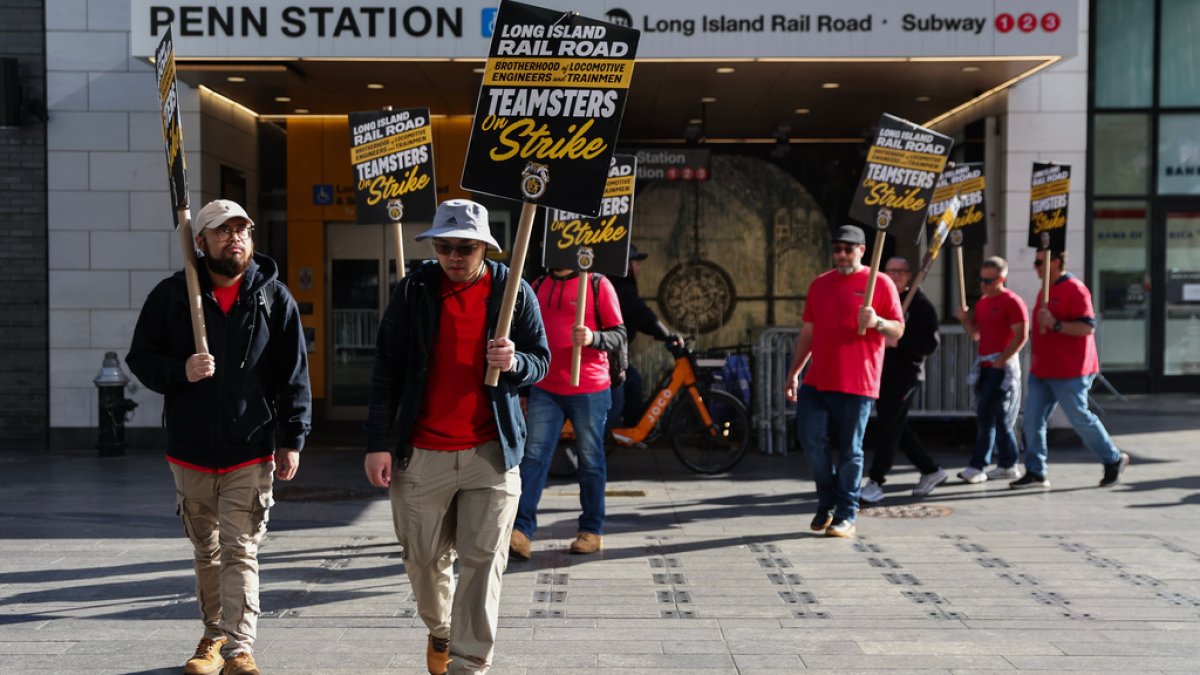
The Long Island Rail Road entered its second day of a strike, shutting down service for roughly 250,000 daily riders and risking major weekday commuting disruption across Long Island and New York City. Negotiations remain stalled over wages and healthcare premiums, with unions arguing for raises to offset inflation and the MTA warning that higher pay could force fare increases of up to 8% next year from 4%. The dispute has become politically charged as Gov. Kathy Hochul and former President Donald Trump trade blame ahead of her reelection campaign.
The immediate market read is not just a transit disruption story; it is a liquidity and governance shock concentrated in Long Island exurbs where commuting is least substitutable. The first-order hit falls on MTA-dependent local activity, but the bigger second-order effect is margin pressure across service employers that cannot fully absorb absenteeism, overtime, and alternative-transport reimbursements if the shutdown extends beyond a few days. That should flow through to local retail, dining, and construction schedules faster than to macro data, but the political feedback loop raises the odds of a rapid settlement because the cost curve steepens nonlinearly after the first weekday commute.
For the MTA, the balance sheet risk is less about lost fare revenue than about the path dependency of any settlement: wage concessions paired with healthcare compromise can lift the next fare reset and force a more defensive stance on capex. That matters because the agency already operates with limited pricing flexibility; any perception that labor costs are being socialized into higher fares increases the probability of political intervention and delayed capital spending. Over a 1-3 month horizon, this is a negative for any infrastructure-linked credits that rely on stable MTA funding optics, while the headline risk remains concentrated in the next 24-72 hours.
The contrarian point is that the market may be overestimating duration but underestimating the policy damage if commuters decide this is a recurring governance failure rather than a one-off strike. A quick deal would unwind most of the disruption premium, but a settlement that is visibly expensive for riders or taxpayers still leaves a residue in electoral and budget risk. If the strike persists into the workweek, the pain is asymmetric: commuters and small businesses absorb the immediate cost, while political actors are forced to choose between labor peace and fare/infrastructure discipline.
AI-powered research, real-time alerts, and portfolio analytics for institutional investors.
Request DemoOverall Sentiment
strongly negative
Sentiment Score
-0.55
Ticker Sentiment
