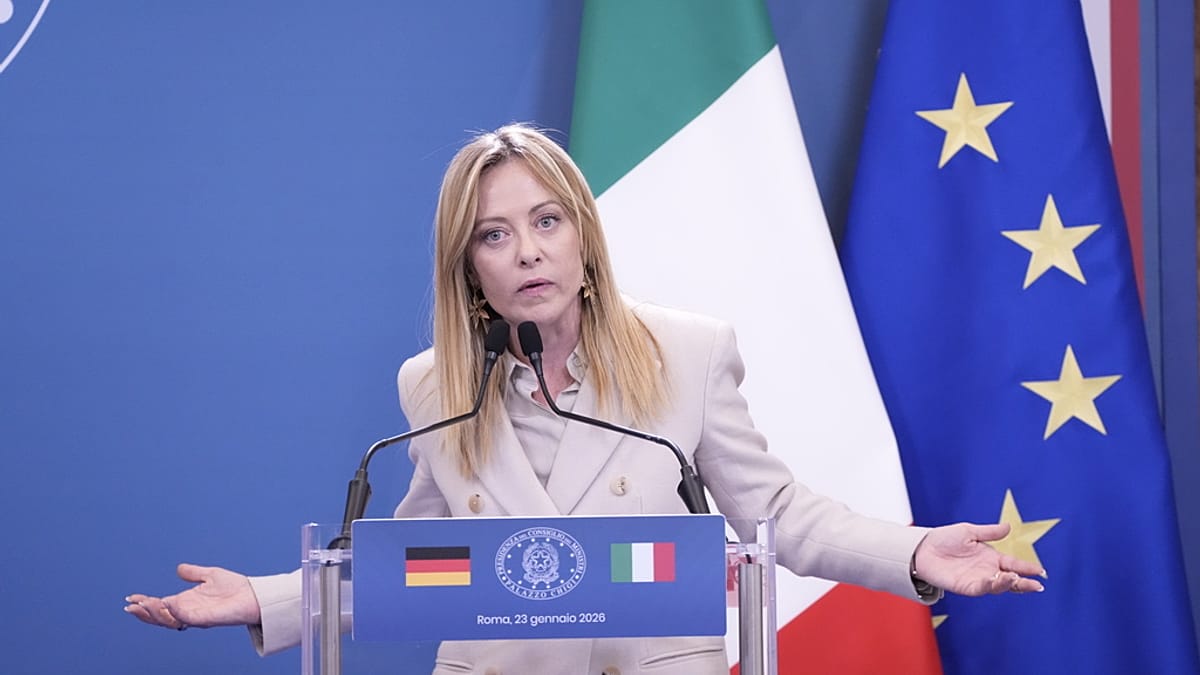
Italian authorities are fast-tracking a security decree after violent clashes in Turin left 108 security personnel injured, including a police officer beaten with a hammer; three arrests were made and more than 20 people were reported on various charges. Prime Minister Giorgia Meloni labelled the attack "attempted murder" and the government is considering measures such as preventive police detention of at least 12 hours, restrictions on knife sales to minors and expanded self-defence rights; officials cited concerns about foreign participants and public order ahead of the Milano-Cortina 2026 Winter Olympics. The episode increases domestic political risk and raises the prospect of tougher security legislation, a factor hedge funds should monitor for potential impacts on investor sentiment, tourism-related sectors and policy-driven regulatory shifts.
Market structure: Rapidly accelerated security legislation in Italy shifts near-term fiscal and procurement flows toward defense, surveillance and policing suppliers (hardware, armored vehicles, PPE, cyber-surveillance). Expect winners to be listed defense/aerospace contractors with Italian exposure (e.g., Leonardo LDO.MI) and airport/venue security integrators, while leisure/tourism operators (SEA.MI, Atlantia ATL.MI) and regional retail footfall beneficiaries face revenue risk ahead of Milano‑Cortina 2026. Pricing power will rise for suppliers able to deliver quickly; expect 3–12 month procurement windows and 10–30% one‑off contract uplifts for compliant prime contractors.
Risk assessment: Tail risks include escalation to nationwide unrest (low-probability <10% over 6 months but high-impact: >50bp BTP widening), heavy-handed laws provoking EU scrutiny, or supply bottlenecks for specialized kit driving margin squeeze for contractors. Immediate (days) impact is headline-driven volatility in Italian equities; short-term (weeks/months) depends on Council of Ministers decisions and market repricing of BTP spreads; medium-term (quarters) on awarded contracts and Olympic security capex. Hidden dependencies: export controls, EU procurement rules, and global supply chains for sensors/semiconductors.
Trade implications: Tactical long bias to Italian defense names (Leonardo) and French/UK primes (Thales HO.PA, BAE.L) via equity or call spreads over 3–12 months; hedge with short positions in exposed travel infrastructure (SEA.MI, ATL.MI) and a modest long in Bundes/US Treasuries if BTP-Bund spreads widen >20bp. Use options to buy upside convexity on defense (3-month call spreads) and buy puts on airport operators (3–6 month puts) as asymmetric plays. Reallocate 2–5% from cyclical travel into security/defense allocations.
Contrarian angle: Consensus treats this as pure risk-off; markets may overshoot selling airport/tourism names near-term while underpricing the structural upside from pre‑Olympics security budgets—if the package passes within 30–90 days, SEA/ATL downside may be mean-reverting. Historical parallels: post‑terror security spend after major events produced multi‑year outperformance for defense primes (+15–40% in 12 months in past cycles). Watch for unintended consequences—privacy litigation or export constraints—that could cap upside for hardware suppliers.
AI-powered research, real-time alerts, and portfolio analytics for institutional investors.
Request DemoOverall Sentiment
moderately negative
Sentiment Score
-0.35
