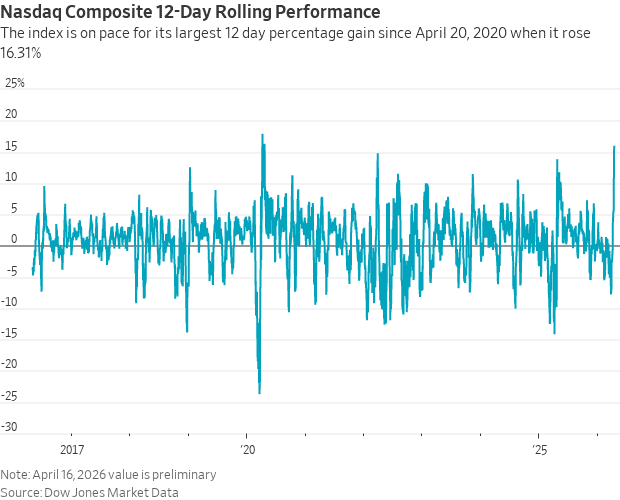
The Nasdaq Composite is on pace for its 12th straight day of gains, which would be its longest winning streak since July 19, 2009. The index is up 15.9% over the last 12 trading days, marking its largest 12-day percentage gain since April 20, 2020. The move points to strong risk-on momentum, though the article is descriptive rather than event-driven.
A 12-day upside streak in the Nasdaq is less interesting as a momentum stat than as a positioning signal: it implies a market that has likely already forced systematic trend followers, dealer hedges, and underinvested long-only accounts to chase higher. In that setup, the near-term marginal buyer can still stay price-insensitive, but the more crowded the tape gets, the more returns become dependent on an uninterrupted macro backdrop rather than company fundamentals.
The second-order effect is a widening dispersion trade beneath the index level. High-beta software, semis, and unprofitable growth names should continue to outperform mechanically while rates stay contained and volatility sellers remain engaged, but that leadership becomes fragile if real yields back up even modestly or if breadth narrows further. The market is effectively paying up for duration, so any rotation into defensives or value would likely hit the most crowded factor exposures first.
The bigger risk is not a dramatic fundamental shock; it is a small macro disappointment that forces de-grossing after an extended one-way move. After a run this strong, even a mild catalyst such as a hotter inflation print, hawkish Fed rhetoric, or a bid-ask liquidity air pocket can trigger a 2-5% mean reversion in the index as systematic strategies cut exposure simultaneously. The rally can persist, but the asymmetry is now poorer than it was a week ago.
Consensus is probably underestimating how much of this move is flow-driven rather than earnings-driven. That matters because flow-driven rallies tend to continue longer than skeptics expect, but they also reverse faster once the incremental buyer disappears. The best contrarian posture is not outright shorting the index; it is fading the most stretched segments while keeping long exposure to the underlying tape through cheaper, better-quality balance sheets.
AI-powered research, real-time alerts, and portfolio analytics for institutional investors.
Request DemoOverall Sentiment
moderately positive
Sentiment Score
0.45
Ticker Sentiment
