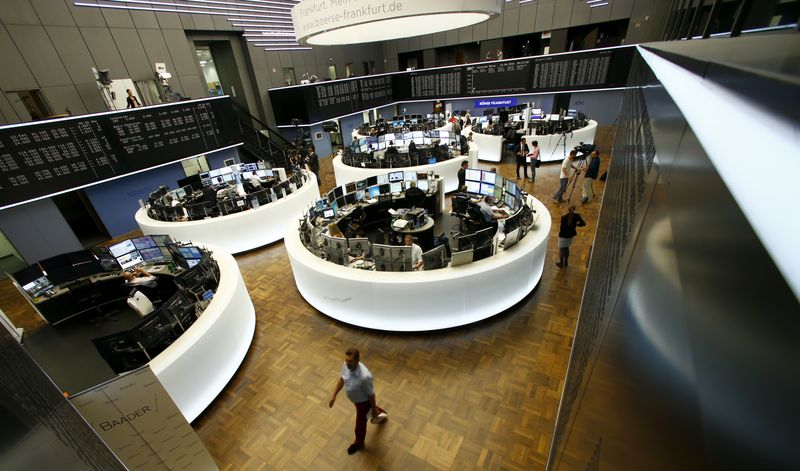
Brent and WTI topped $100 a barrel as the Iran conflict and a U.S.-Iran impasse kept the Strait of Hormuz effectively blocked, raising the risk of a broader energy shock. European equities were broadly lower, while investors also focused on a likely unchanged Fed rate decision later in the day. Company earnings were mixed: Adidas rose more than 7%, UBS jumped on an 80% profit increase, and STMicroelectronics and Airbus gained, while GSK fell over 3% and Aena weakened.
The market is treating this as a classic oil shock, but the more interesting edge is that the first-round winners are not the obvious energy names—they're the balance-sheet-sensitive financials and industrials with pricing power and USD-linked revenue. For UBS and Santander, higher volatility and higher-for-longer rates can support trading income and net interest margins in the near term, while the real risk is a delayed credit-quality turn over the next 2-4 quarters if energy spikes start hitting European consumer and SME balance sheets. That makes bank beta attractive only as a tactical trade, not a medium-term compounder here.
STM looks like the cleanest semiconductor beneficiary because the market is still underestimating how much of its earnings base is tied to auto and industrial end-demand rather than pure AI. If oil stays elevated, the second-order effect is a slower European auto production cycle and weaker discretionary spending, which can offset the valuation support from “inflation hedge” narratives. In other words, STM can work on a short squeeze basis, but the fundamental impulse is less durable than the price action suggests.
GSK’s weakness is a signal that defensives are no longer being paid for safety when inflation expectations are re-accelerating and the Fed is unlikely to cut into an energy shock. That creates a relative-value setup: duration-sensitive defensives and rate proxies can underperform even if earnings are stable, because the market will demand a higher discount rate for lower-growth cash flows. The biggest tail risk is not just oil at a higher level, but oil staying high long enough to reprice central-bank reaction functions and compress equity multiples across Europe.
Consensus is probably overestimating how quickly geopolitical supply can normalize and underestimating how fast the macro transmission hits via rates, FX, and consumer demand. The move is still early enough that momentum can continue for days, but over a multi-month horizon the better expression is to own inflation beneficiaries and fade expensive defensives and rate-sensitive cyclicals. If tanker flow remains constrained for another 2-3 weeks, expect a broader earnings reset across European consumer and transport names, not just energy.
AI-powered research, real-time alerts, and portfolio analytics for institutional investors.
Request DemoOverall Sentiment
mildly negative
Sentiment Score
-0.20
Ticker Sentiment
