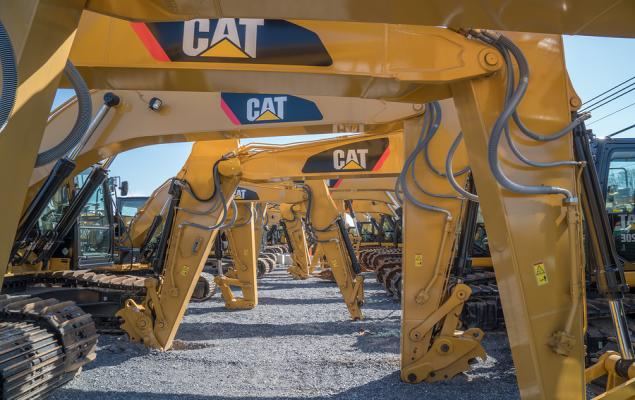
Caterpillar (CAT) is trading at a premium P/E of 17.74x compared to its industry average of 16.69x, raising valuation concerns amid declining revenues and volume trends; shares are down 3.9% YTD, underperforming its industry and the S&P 500. The company anticipates flat to slightly declining revenues in 2025, with earnings estimates also trending downward, although long-term growth is expected from infrastructure projects and increased demand for mining equipment and data center engines. While a new CEO has taken the helm, existing shareholders may benefit from CAT's solid financial position, high ROE, and dividend yield of 1.61%.
Caterpillar Inc. (CAT) is currently trading at a forward 12-month price/earnings ratio of 17.74X, a premium compared to the manufacturing - construction and mining industry average of 16.69X and significantly above peers such as Komatsu (10.41X) and Terex Corporation (9.52X). This valuation is coupled with several operational challenges: CAT has reported six consecutive quarters of volume declines, with its Resource Industries segment down for seven quarters and Construction Industries for six. Consequently, revenues have been declining for the past five quarters, and earnings have fallen in the last three, partly due to the downturn in China's real estate sector. Year-to-date, CAT shares have lost 3.9%, underperforming its industry's 2.9% decline and the S&P 500's 0.3% fall. For 2025, Caterpillar projects revenues to be flat (excluding tariffs) or slightly lower year-over-year (including tariffs), and the Zacks Consensus Estimate for 2025 earnings indicates a 14.5% year-over-year decline, with revenues expected to drop by 2.4%. Broader economic indicators, such as the ISM manufacturing index remaining largely in contraction, further cloud the near-term outlook. Despite these headwinds, long-term fundamentals appear intact, supported by the U.S. Infrastructure Investment and Jobs Act, growing demand for mining equipment due to the clean energy transition, robust orders for data center engines, and an increasing focus on high-margin aftermarket services. The company maintains a strong return on equity (ROE) of 53.77% and offers an attractive dividend yield of 1.61%, with a 30-year history of dividend increases. The recent leadership change, with Joseph Creed taking over as CEO on May 1, will be closely watched as he navigates these challenges.
AI-powered research, real-time alerts, and portfolio analytics for institutional investors.
Request DemoOverall Sentiment
mixed
Sentiment Score
-0.10
Ticker Sentiment
