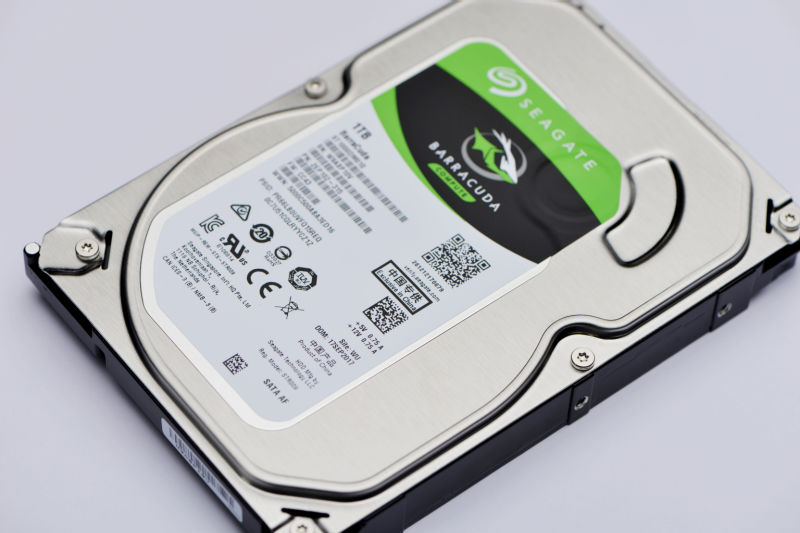
Seagate Technology shares jumped 5.5% to a new 52-week high of $930.98 after NVIDIA’s RTX Spark PC AI announcement, multiple analyst target raises, and removal of a major legal overhang. Barclays lifted its target to $1,000 from $750, while Wells Fargo and BofA raised targets to $900; Seagate also agreed to a $175 million settlement tied to export-control allegations involving Huawei. Fundamentals remain strong, with Q3 fiscal 2026 EPS of $3.39 on revenue of $3.11 billion, up 44% year over year, and Q4 revenue guidance of about $3.45 billion.
STX is behaving less like a cyclical hardware name and more like a scarcity asset: the market is starting to price in a multi-year pricing regime where capacity discipline, not unit growth, drives earnings power. The key second-order effect is that HDDs are regaining strategic relevance in AI infrastructure because bulk storage economics still matter for training data lakes, archival, and checkpointing, even as accelerators get the headlines. That creates a cleaner relative setup for STX than for the broader semiconductor group, because the upside is tied to tight supply and contract resets rather than to a single product-cycle beat.
The legal overhang removal matters mostly because it improves the terminal multiple, not just near-term sentiment. When a company moves from being viewed as litigation-capital-constrained to capital-flexible, buybacks, debt optimization, and longer-dated margin expansion all become easier for the market to underwrite. The likely next leg is not another re-rating on one more analyst target increase; it is estimate revisions if pricing remains firm into the year-end contract cycle and if management uses cleaner balance sheet optics to lean into shareholder returns.
The contrarian risk is that the trade is now crowded around a narrative the market already broadly accepts: AI storage demand, higher HDD pricing, and improved fundamentals. If the mix shift to higher-capacity drives is slower than expected, or if enterprise capex gets deferred for even one quarter, the stock can de-rate quickly because it is already priced for execution. The bigger medium-term risk is that consensus may be overestimating how durable the pricing umbrella is if competitors add supply or if cloud customers push back on procurement terms after the current renewal window.
NVDA is the indirect beneficiary, but the read-through is subtle: personal AI PC messaging supports a broader AI refresh cycle, yet that mostly helps the storage ecosystem at the margin rather than changing the accelerator demand pool. WFC’s more constructive stance is a useful tell that the market is beginning to treat storage as an earnings-quality story, not just a cyclical rebound. That makes the setup vulnerable to disappointment only if the next fundamental print fails to confirm the new higher base.
AI-powered research, real-time alerts, and portfolio analytics for institutional investors.
Request DemoOverall Sentiment
strongly positive
Sentiment Score
0.72
Ticker Sentiment
