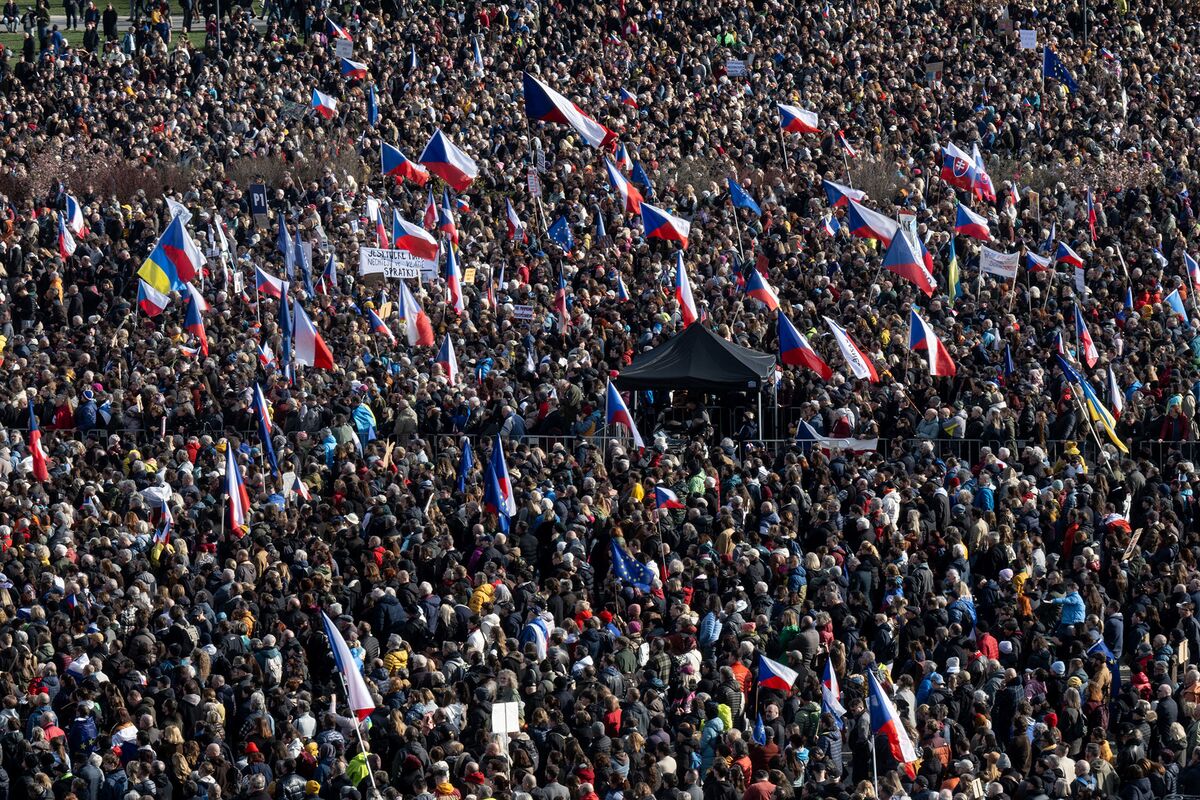
Over 200,000 people rallied in Prague against Prime Minister Andrej Babis, according to the organizer, in a protest highlighting alleged democratic backsliding. The demonstration underscores rising political risk and governance concerns in the Czech Republic; near-term market impact is likely limited but could increase policy and investor uncertainty if protests persist or escalate.
Political unrest in a small, open EU economy transmits disproportionately through three channels: FX, banks, and state-linked corporates. A sustained period (4–12 weeks) of headline risk typically widens CZK sovereign spreads by 20–80bps and knocks 5–12% off domestically focused bank P/TBV multiples as deposit flight and uncertainty on enforcement of EU funds increase funding premia. Utilities and infrastructure names with material state ownership or regulatory exposure see valuation multipliers compress as the probability of intervention rises by an incremental 10–30% in stressed scenarios, creating an asymmetric downside vs peers in Germany/Poland.
Second-order supply-chain effects are concentrated in EU subsidy- and procurement-dependent sectors: construction and environmental services firms with >15% revenue from public contracts face a 2–4 quarter lag before orderbooks re-price, amplifying FY+1 EPS downside even if cabinet instability resolves quickly. Conversely, exporters with substantial non-EU revenues (tourism down; industrial exporters up) can see relative outperformance as capital flees domestic-risk assets into FX-hedged global earners. Monitor EU Commission communications — a formal rule-of-law referral or funding suspension would be the fastest path from political noise to real cashflow impairment (likely within 1–3 months if escalated).
The practical trade framework is to treat this as a volatility and policy-risk event, not a permanent regime change unless you see coalition fracturing or EU funding action. Short-duration tactical instruments (6–12 week) capture the initial repricing; longer-term positions (6–18 months) should be conditional on concrete catalysts (resignation, early election announcement, or EU procedural steps). Liquidity is limited in Prague-listed options — prefer equity pair trades, regional swaps, or FX/credit instruments where available to implement directional views with controlled skew exposure.
AI-powered research, real-time alerts, and portfolio analytics for institutional investors.
Request DemoOverall Sentiment
neutral
Sentiment Score
0.00
