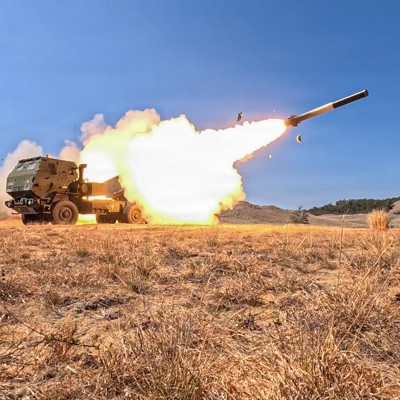
The article describes a live-fire amphibious defense exercise in the Philippines involving U.S., Filipino, and Japanese forces, with HIMARS, drones, artillery, helicopters, and unmanned vessels used to simulate repelling a seaborne attack. The drills, held less than 400 miles from Taiwan, highlight U.S. and allied efforts to improve joint interoperability and maritime strike capability in the Indo-Pacific. The piece is strategically important for defense and geopolitics, but it does not present an immediate market-moving event.
The signal is not the exercise itself; it is the industrialization of a Pacific denial architecture. The market takeaway is a faster procurement loop for distributed sensing, expendable drones, loitering munitions, mobile rocket artillery, and maritime target discrimination — all capabilities that favor firms able to ship cheap, modular, software-upgradable systems at scale rather than exquisite platforms with long integration cycles. That tends to benefit the full stack of autonomy, comms, EW, ISR, and launch-system suppliers more than prime contractors exposed to slow-turn legacy programs.
Second-order, this reinforces a procurement shift toward attritable systems that can survive in a high-loss environment. The near-term winners are likely to be companies with exposure to one-way attack drones, tactical UAS, ruggedized sensors, secure mesh networking, and fire-control software; the losers are platform-centric vendors whose value proposition depends on air superiority or uncontested logistics. A less obvious beneficiary is the domestic manufacturing base for small motors, batteries, optics, and RF components, because “good enough and abundant” is becoming more important than premium performance.
The contrarian risk is that investors may be overpaying for the defense-autonomy theme on a three-to-five-year story while the actual budget effect could lag. The relevant catalyst window is 6-18 months: if allied exercises translate into funded programs, contract awards, and repeat orders, the trade works; if the Pentagon keeps treating these as experiments rather than programs of record, the equity rerating fades. Another risk is that the fastest gains accrue to non-listed suppliers or to primes with better political distribution, not to the obvious drone pure plays.
A more subtle implication is escalation management: capabilities designed to deny an amphibious approach are politically easier to fund than offensive systems, so the mix can expand quickly even under tighter defense budgets. That makes this a “buy the picks and shovels, not the flagship” environment, with the strongest payoff likely in enabling technologies that are fungible across Army, Marine, Navy, and allied users.
AI-powered research, real-time alerts, and portfolio analytics for institutional investors.
Request DemoOverall Sentiment
neutral
Sentiment Score
0.05
