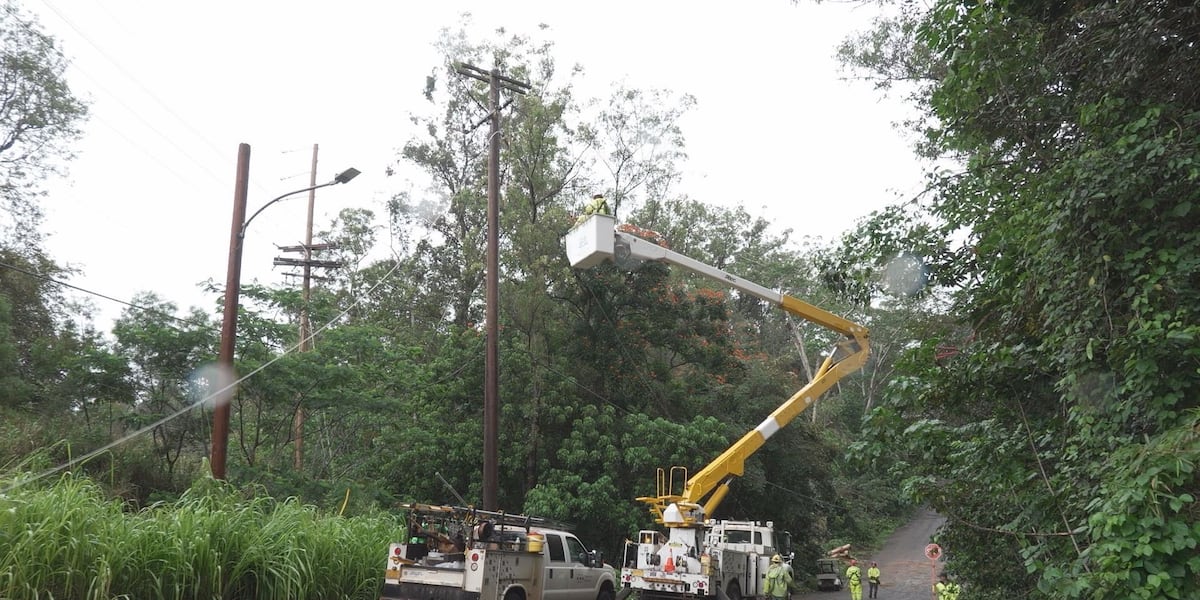
HECO reports about 114,000 customers without power across Oahu, Maui and Hawaii Island after wind, heavy rain, fallen trees and lightning damaged lines; crews have restored roughly 186,000 customers as of 5 p.m. Breakdown: Oahu ~70,000 customers out (23%), Maui ~15,700 (22%), Hawaii Island ~28,300 (31%). Damage includes two transmission lines to East Honolulu with one remaining line also hit; repairs may take hours to days due to mountainous terrain, flooding and road closures, though HECO does not expect to use Public Safety Power Shutoffs.
Near-term winners are vendors and installers of portable backup power, battery-plus-solar retrofits, and road/utility contractors that can mobilize quickly to confined, terrain-challenged sites; these are revenue bursts that can extend into a multi-quarter replacement cycle as households and municipalities accelerate resilience upgrades. Expect tighter retail inventory for portable generators and spiking OEM lead times to sustain aftermarket margins for 1–3 quarters, while residential solar + storage demand can drive multi-year upgrade cycles because outages expose the value of islanded capability.
A key second-order effect is supply-chain concentration risk for specialized transmission work: crews, helicopters, and high-voltage stringing hardware are finite, so outages that require mountain access create bottlenecks that push repair timelines from days into weeks and prioritize high-customer-count circuits. That creates an asymmetric flow of emergency capex toward firms with aerial/rope-access crews and local staging yards — beneficiaries are not generic construction names but those with island logistics footprints or national-scale rapid-deployment services.
Tail risks include a prolonged repair regime (months) that triggers regulatory scrutiny and potential fast-tracked rate-base approvals for grid hardening, which would be structural upside to regulated utility suppliers but a headline risk to insurers and tourism-dependent issuers if airport/transport disruptions compound. The consensus underestimates how intermittent but severe weather events catalyze durable demand for behind-the-meter resiliency (batteries, hybrid inverters) versus one-off temporary fixes; that favors manufacturers and integrators over pure disaster-restoration contractors once the first-wave restoral work completes.
AI-powered research, real-time alerts, and portfolio analytics for institutional investors.
Request DemoOverall Sentiment
neutral
Sentiment Score
0.00
