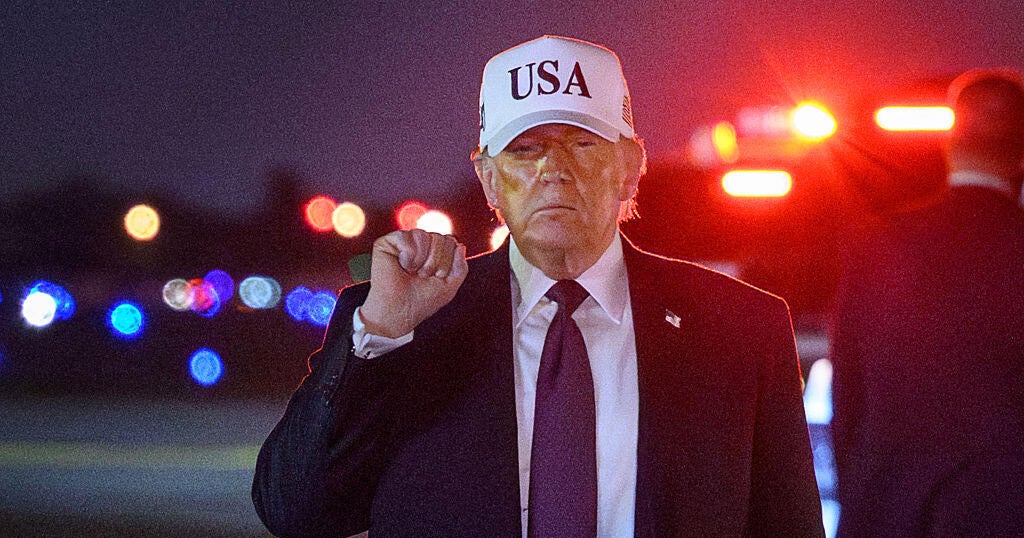
President Trump signaled willingness to engage with Iran's new leadership after Supreme Leader Ayatollah Ali Khamenei and dozens of senior Iranian officials were killed in Israeli airstrikes, while the U.S.-led bombing campaign (dubbed Operation Epic Fury) continues. The strikes have left Iran without a clear successor, complicating regional stability and derailing ongoing U.S.-Iran negotiations over nuclear, missile and proxy issues; White House commentary and Senate remarks underscore heightened uncertainty that could drive risk-off positioning across markets.
Market structure: Immediate winners are large-cap defense contractors (LMT, NOC, RTX) and integrated oil majors (XOM, CVX) as procurement budgets and oil risk premia rise; losers are airlines (AAL, UAL), cruise lines (CCL), EM exporters/financials and Iranian-linked energy firms. Pricing power shifts toward suppliers of munitions, ship insurance providers and freight re-routing services; marginal barrel flows via alternative routes will raise freight and refining logistics costs by an estimated 5–15% if disruptions persist beyond 2–6 weeks. Cross-assets: expect WTI +10–25% on Strait-of-Hormuz disruption, gold +5–15% in days, USD and Treasury 10yr yields bid lower by 5–30bp as safe-haven flows arrive, and equity implied vols across energy/defense jump 30–70% intraday.
Risk assessment: Tail scenarios include direct US-Iran kinetic escalation or closure of Hormuz (low-probability ≈10–20% next 90 days) causing oil >$120/bbl and S&P drawdown 15–30% within weeks. Immediate (0–7 days): volatility spikes and knee-jerk flows; short-term (1–3 months): supply-chain and insurance cost pass-through raising CPI by 30–60bp; long-term (1–3 years): sustained defense budget increases 5–15% and EM capital flight. Hidden dependencies: shipping insurance clauses, sovereign bond covenants, semiconductor supply nodes in the region; catalysts to watch: Iranian succession announcement, confirmed Hormuz incidents, OPEC+ emergency meetings.
Trade implications: Favor convex, event-driven exposure: shorter-dated call spreads on WTI and targeted long positions in LMT/RTX with hedges, paired with short cyclicals (airlines/cruise). Use options to size tail protection (buy puts on SPX or VIX calls) rather than outright large net shorts; increase USD and gold exposure in 1–4 week window if strikes intensify. Rebalance if de-escalation signals appear (diplomatic engagement or cessation of strikes) within 7–21 days.
Contrarian angles: Consensus may overpay defense names now—if talks resume (Trump indicated willingness) a rapid de-risk could produce 15–30% mean reversion in oil and 10–20% in defense ex-post. Historical parallel: 2019 tanker attacks caused a brief oil spike that faded within 2–3 months once shipping resumed; therefore use option structures to capture upside while limiting carry and gamma risk. Unintended consequence: prolonged strikes that kill governance depth in Iran could create multi-year regional volatility, not a short spike—size positions accordingly.
AI-powered research, real-time alerts, and portfolio analytics for institutional investors.
Request TrialOverall Sentiment
moderately negative
Sentiment Score
-0.60
