
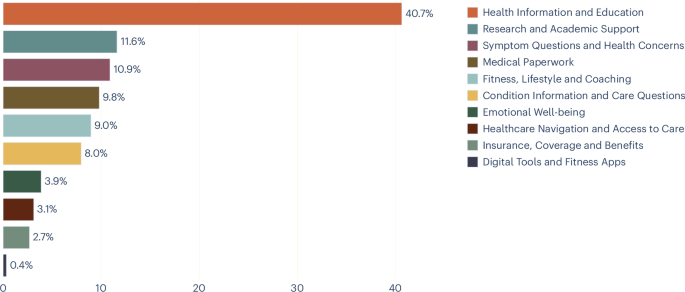
Microsoft’s Copilot health-queries study finds 617,827 de-identified conversations in January 2026, with 40.8% classified as Health Information and Education and nearly one in five involving personal symptom or condition discussions. Mobile usage skews toward personal health concerns, while desktop is dominated by research and medical paperwork; one in seven personal-health queries are about someone other than the user. The article is primarily a product-usage and safety analysis with implications for AI design and privacy, rather than a direct market-moving event.
This is less a growth headline than a product-segmentation map for MSFT: health usage is bifurcating into consumer triage/support on mobile and workflow-adjacent productivity on desktop. That matters because the monetizable surface area is different by device—mobile health is more likely to drive retention, trust, and eventual premium consumer bundles, while desktop is where Copilot can defend share in higher-ARPU knowledge-work workflows such as research, paperwork, and admin automation. The second-order read-through is that Microsoft’s strongest health wedge may not be clinical diagnosis, but the unglamorous layer between consumer intent and the care system.
The more interesting signal is timing. If personal health intent clusters at night, the user is often in a higher-anxiety, lower-support context, which raises both conversion potential and liability. That creates a design imperative: Microsoft will need stronger escalation and guardrail pathways exactly when engagement is highest, or a single well-publicized failure could become a platform-wide trust event. Over the next 3-12 months, the risk is not demand weakness but policy and safety scrutiny as usage patterns make it obvious that generalist AI is being used as quasi-medical advice after-hours.
The caregiver share is an overlooked expansion vector. If ~15% of symptom/condition queries are about someone else, the TAM is broader than personal wellness and includes parents, adult children, and partners managing care logistics—an audience that values context retention, family-mode memories, and handoff features more than raw model IQ. Competitively, that favors platforms that can anchor identity, device continuity, and document handling across sessions; it is a subtle tailwind for Microsoft’s ecosystem integration versus chat-only competitors. The contrarian view is that the market may underprice how much health AI becomes an attachment feature for productivity suites rather than a standalone medical product.
AI-powered research, real-time alerts, and portfolio analytics for institutional investors.
Request TrialOverall Sentiment
neutral
Sentiment Score
0.10
Ticker Sentiment
