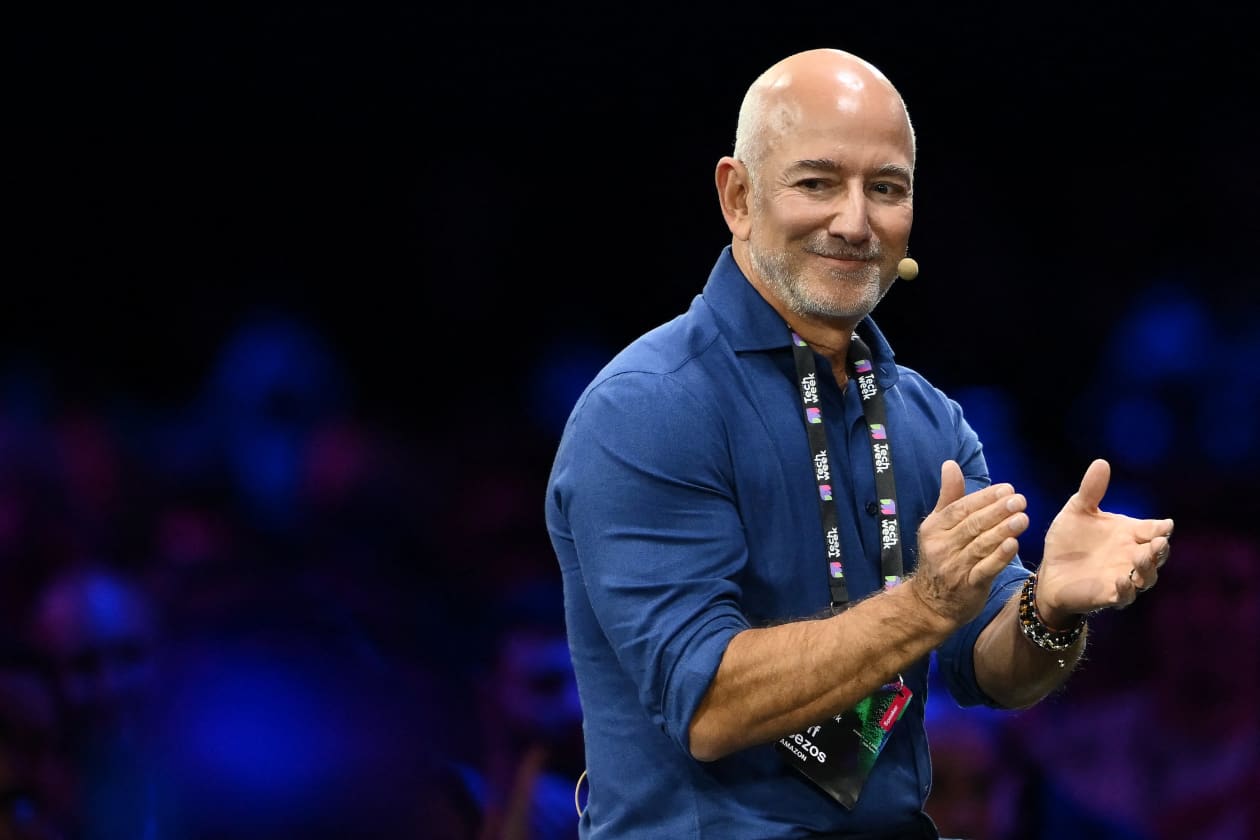
Jeff Bezos said timelines for orbital AI data centers are "probably not right," calling Elon Musk’s 2- to 3-year forecast for space-based data centers "a little ambitious." The comments underscore that the technology remains speculative and that no clear commercialization timeline exists yet. The piece is more about long-dated innovation than immediate financial impact.
The key market takeaway is not whether orbital data centers are feasible, but that the commercialization window is long and highly uncertain. That pushes the economic value chain toward terrestrial enablers over the next 12-36 months: power generation, grid equipment, liquid cooling, photonics, launch infrastructure, and high-reliability semiconductors. In other words, the near-term monetization path is still on Earth, even if the narrative premium migrates to space.
The second-order effect is a potential capital-allocation trap for investors extrapolating AI infrastructure demand into futuristic capex too early. If investors start discounting space-based compute as a meaningful capacity outlet, it could soften the perceived scarcity premium in land, power, and data-center real estate names without any actual supply coming online for years. That creates a mismatch: the market may price in future relief on compute bottlenecks before the bottlenecks are economically solvable.
A more subtle implication is competitive positioning among hyperscalers and AI model operators. Any company that can secure energy, permitting, and cooling today retains a structural advantage, because orbital compute is still a physics-and-reliability problem, not a software problem. If the timeline slips materially, the beneficiaries are incumbents with large terrestrial footprints and vendors selling picks-and-shovels to them; the losers are speculative “space infrastructure” narratives that depend on far-distant optionality.
Contrarian view: the consensus may be underestimating how quickly the conversation can shift from “if” to “where does early demand show up first.” Even if orbital data centers are not viable in 2-3 years, small demonstrations can still re-rate adjacent names by validating long-duration demand for launch, thermal management, and radiation-hardened components. But that is a narrative trade, not a fundamental cash-flow trade, and the gap between those two is likely to widen before it narrows.
AI-powered research, real-time alerts, and portfolio analytics for institutional investors.
Request DemoOverall Sentiment
neutral
Sentiment Score
-0.05
