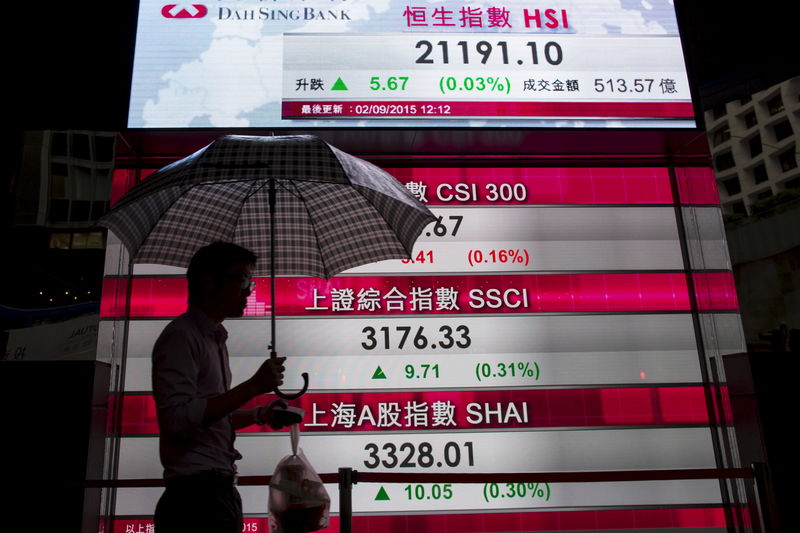
Asian stocks fell as renewed Middle East tensions and stalled U.S.-Iran peace talks kept crude prices above $100 per barrel, pressuring risk assets and stoking inflation concerns. South Korea's KOSPI slipped 0.4%, Shanghai Composite lost 0.5%, Hong Kong's Hang Seng fell 0.5%, and Australia's S&P/ASX 200 dropped 0.5%. Japan's core CPI rose to 1.8% year-on-year in March from 1.6% in February, still below the BOJ's 2% target ahead of next week's policy meeting.
The market is pricing a classic cross-asset tug-of-war: geopolitical risk is keeping the energy bid intact while higher oil is quietly becoming a tightening impulse for Asia ex-Japan. The second-order effect is that the most rate-sensitive pockets in the region — high-multiple growth, consumer discretionary, and import-dependent industrials — are likely to see multiple compression even if earnings hold up, because input-cost pressure and stickier inflation reduce room for policy easing.
Japan is the key hinge. A still-sub-2% core print does not remove the setup for a BOJ normalization signal, which matters because Japanese equities have been trading on the assumption of benign policy and persistent FX support. If the BOJ shifts language toward tightening, the immediate winner is the yen and domestically financed banks, but the more interesting loser is the levered exporter complex if USD/JPY stalls or reverses; that would hit auto, machinery, and broader quality-growth names that have benefited from a weak currency regime.
The tech drawdown looks more like a positioning unwind than a fundamental break, but that still matters because crowded AI names are the market’s highest beta liquidity source. If oil stays elevated and yields stop falling, the factor mix becomes hostile to long-duration growth, so expect relative underperformance in semis and software versus energy, defensives, and financials over the next 2-6 weeks. In that regime, the risk is not an outright bear market but a leadership rotation that punishes consensus momentum trades faster than macro investors expect.
Consensus may be underestimating how quickly energy-driven inflation bleeds into policy expectations across Asia. The market is treating this as a headline risk event, but if crude remains above the psychological threshold for another 2-4 weeks, it starts to impair margin guidance, capex appetite, and rate-cut expectations simultaneously — a much more durable headwind than the initial geopolitical shock.
AI-powered research, real-time alerts, and portfolio analytics for institutional investors.
Request TrialOverall Sentiment
mildly negative
Sentiment Score
-0.28
