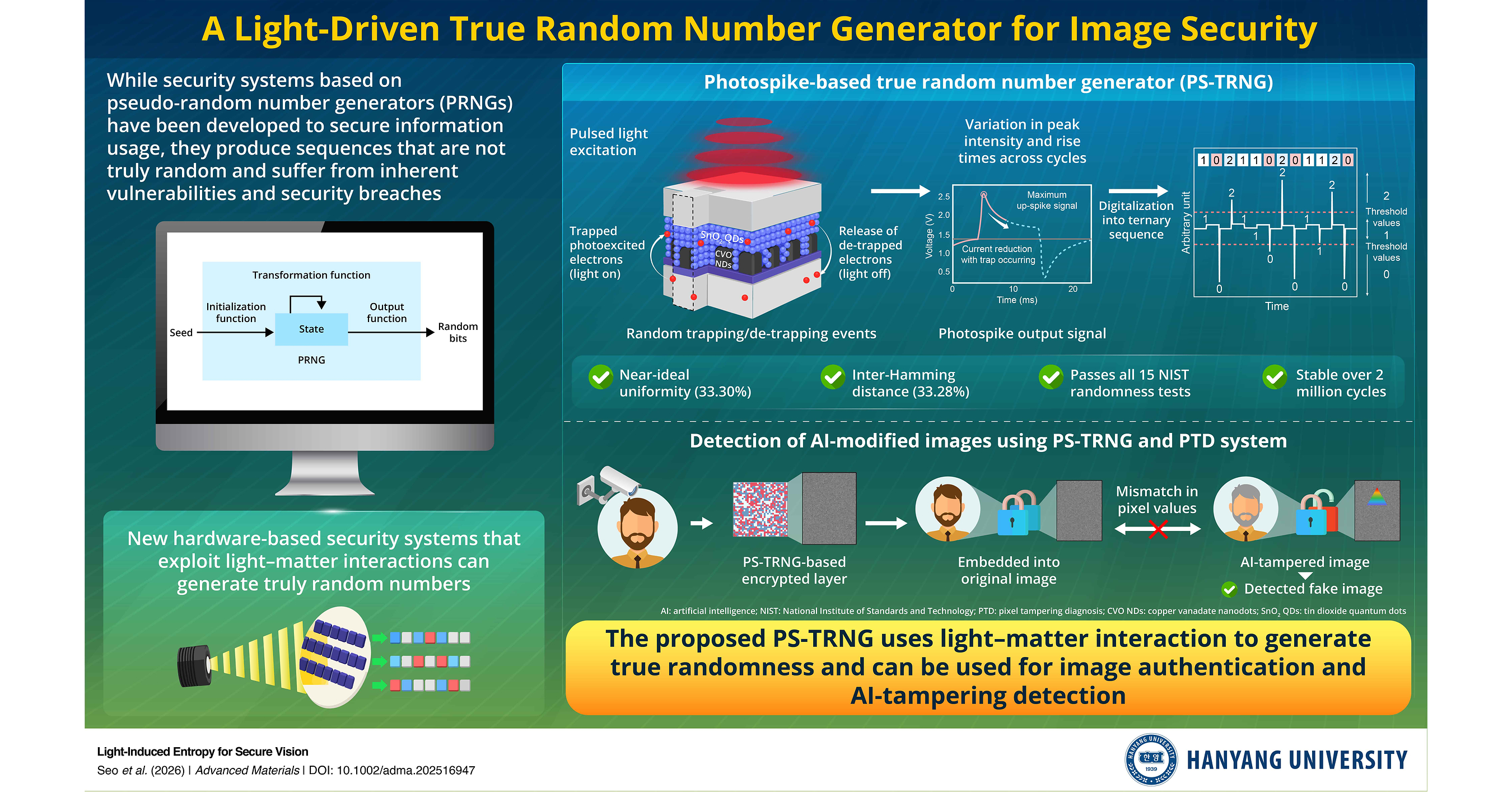
Hanyang University researchers unveiled a photospike-based true random number generator (PS-TRNG) that converts light-induced charge trapping/release into real-time ternary random numbers (0/1/2) with near-ideal statistical balance. The output passed all 15 NIST randomness tests and remained stable over 2M+ operating cycles and 460 days, while being embedded into images as hidden security signatures to detect tampering and pixel-level AI-forgery/deepfake modifications without visible quality loss.
This is a credible technical proof-of-concept, but the marketable value is not the entropy generator itself — it is whether camera OEMs, smartphone ISPs, and regulated workflows adopt a hardware-rooted provenance standard. Near term, that is an R&D headline, not a revenue event; the economic payoff sits 6-18 months out and depends on standardization, not lab performance. The first commercial buyers would likely be in chain-of-custody-heavy verticals such as legal, insurance, medical imaging, and identity verification, where fraud loss reduction can justify modest BOM additions.
Second-order, the likely winners are companies that sit at the trust layer: identity verification, forensic tooling, and content authenticity software. If hardware signatures become embedded at capture, standalone post-hoc deepfake detection tools lose pricing power because the best defense shifts upstream into device authentication; that is more disinflationary for reactive security software than bullish for generic AI infra. The harder-to-quantify upside is for sensor and image pipeline vendors that can sell secure modules or premium SKUs, but that requires OEM design wins and standards alignment, which usually takes multiple product cycles.
Contrarian view: the consensus may be overestimating how much of the problem needs a novel entropy source. Most enterprise demand is likely to settle for provenance, watermarking, and cryptographic attestations that are cheaper and software-deployable today; if so, this remains scientifically interesting but commercially secondary. Falsifiers are simple: no announced OEM integration, no standards body traction, or no mention of secure-image requirements in 2026-2027 handset/camera roadmaps.
AI-powered research, real-time alerts, and portfolio analytics for institutional investors.
Request TrialOverall Sentiment
mildly positive
Sentiment Score
0.25
