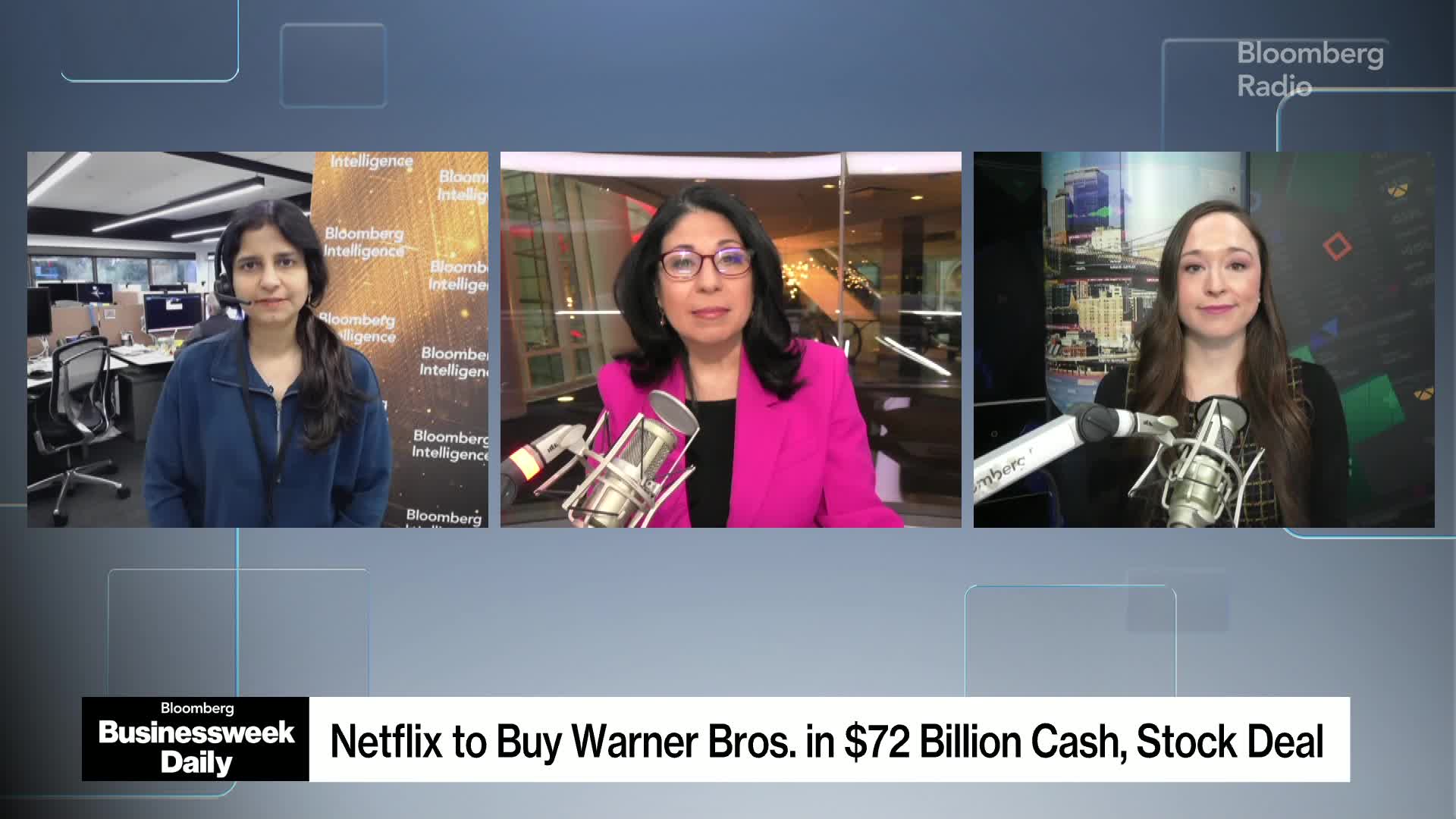
Netflix is acquiring Warner Bros.' studio and streaming assets while the cable networks business (CNN, TNT, TBS) will be spun off into a separate company, Discovery Global, with the split expected by mid‑2026/3Q26. The networks unit is projected to generate roughly $5.0–5.5 billion of EBITDA in 2026 and Warner Bros. Discovery shares have rallied; Wells Fargo led a roughly $60 billion bridge loan to finance the deal, and a $2.8 billion break fee applies to rival bidders. Key risks for investors are regulatory/antitrust scrutiny hinging on market definition (streaming vs. total TV/YouTube) and potential licensing/ theatrical‑release concessions; Paramount and Comcast remain possible suitors or agitators, leaving the process open to further bids or a hostile approach.
Market structure: The Netflix acquisition of Warner’s studio/streaming assets concentrates premium IP with NFLX while spinning off the cable networks (Discovery Global) that will generate ~ $5–5.5bn EBITDA in 2026 but face secular ad/affiliate declines. Immediate winners: Netflix (content scale, pricing power in streaming) and arranging banks (Wells Fargo) via fees; losers: pure-play linear-network owners and ad-dependent media names. The deal materially changes bargaining leverage for streaming licensing and increases Netflix’s share of premium scripted supply versus rivals (Disney/GOOGL) ahead of a likely Q3 2026 close.
Risk assessment: Key tail risks are (1) an adverse antitrust remedy or block if regulators define the market narrowly (streaming subscribers) within the next 6–18 months, (2) a financing shock if bridge loan syndication stalls ($60bn bridge) widening credit spreads, and (3) content-licensing retaliation if Netflix restricts third-party licensing. Near-term volatility will cluster around regulatory filings, potential rival bids (Paramount/Comcast) and the 18-month “road” flagged by management; the $2.8bn break fee is a known downside buffer but not a blocker to hostiles.
Trade implications: Bancassurance and loan-origination wins favor WFC (fee revenue) in the next 3 months; consider merger-arb exposure to NFLX using long-dated call spreads (capture upside to Q3 2026 close) rather than outright stock given regulatory tail risk. Credit markets: buy protection or underweight high‑yield media bonds (12‑18 month horizon) as licensing/EBITDA mix shifts; options vols around NFLX/WBD will reprice on regulatory news—use defined‑risk spreads.
Contrarian angles: The market underestimates the floor value of Discovery Global — at ~5.5bn EBITDA even a 6x–7x buyer multiple implies a $33–38bn enterprise value that could attract strategic consolidators, capping downside. Also, if Netflix maintains wide licensing rather than exclusive pulls, legacy licensors (DIS, GOOGL) benefit from higher prices — suggesting a tactical long GOOGL vs short pure cable/linear names (CMCSA) through 12 months. Historical parallels (large studio consolidation) show regulatory outcomes are binary; size your positions for asymmetric payoff, not linear beta.
AI-powered research, real-time alerts, and portfolio analytics for institutional investors.
Request DemoOverall Sentiment
mixed
Sentiment Score
0.12
Ticker Sentiment
