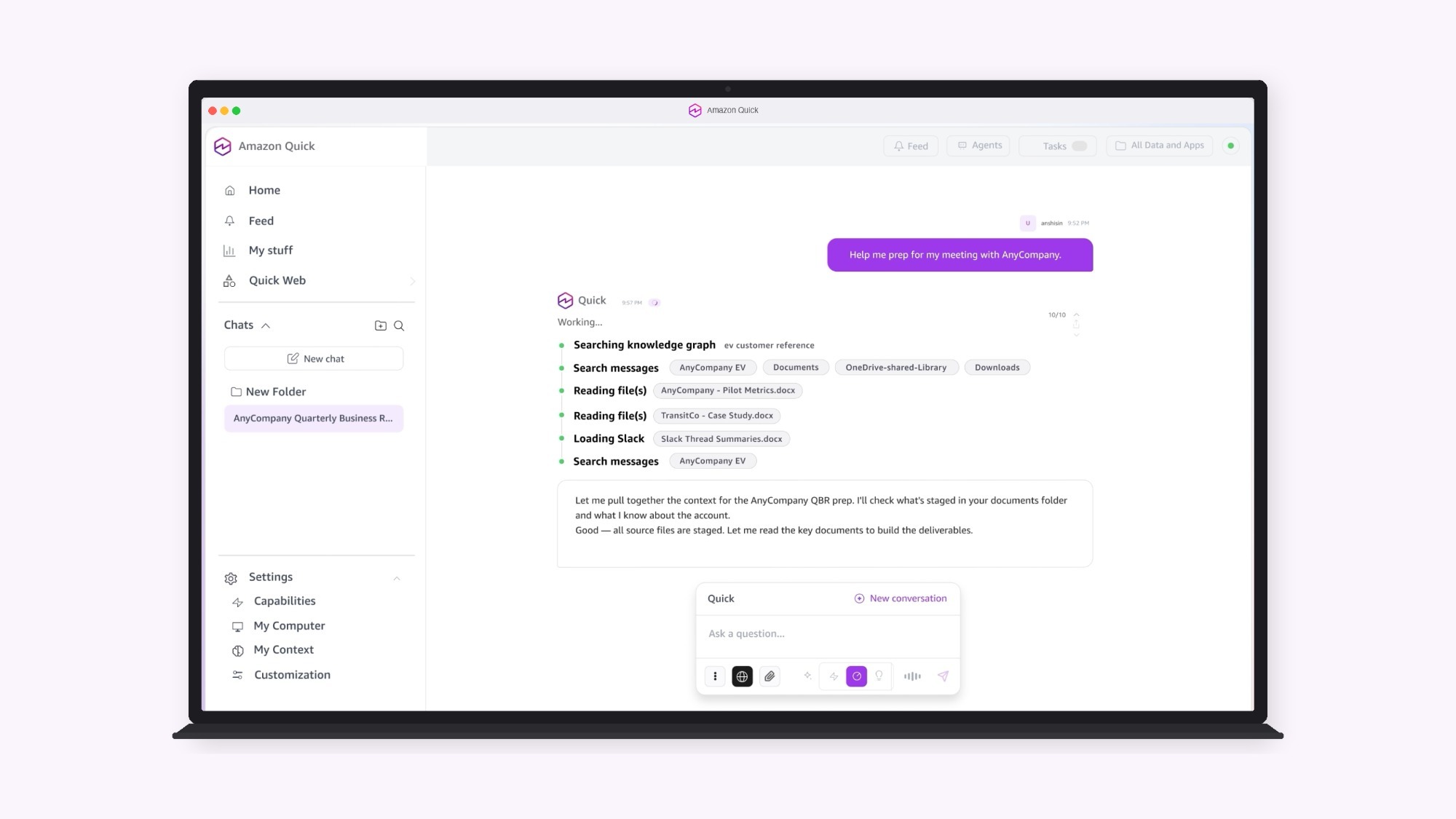
Amazon launched a new desktop app for Quick, its AI assistant, alongside expanded content-generation and integration features. The update adds background access to local files, calendar, email, and workplace apps, plus new capabilities for building dashboards, apps, presentations, and images, while emphasizing enterprise security and privacy. Adoption examples from New York Life, Mondelēz, and 3M suggest meaningful productivity gains, though the announcement is primarily a product-expansion story rather than a direct financial catalyst.
This is less a product launch than an attempt to redefine the control point for enterprise AI: the desktop layer becomes the moat, not the model. If the workflow truly shifts from query-based usage to ambient, cross-app orchestration, the economic value accrues to the platform that can sit closest to identity, permissions, and daily behavior—raising the switching costs for point tools across collaboration, CRM, and analytics. The second-order effect is pressure on standalone workflow vendors whose value prop is “one more app” rather than a system-wide memory layer.
The near-term winners are the distribution and integration beneficiaries. AMZN gets a higher-value seat in the enterprise stack, while DBX, GDDY, and MDLZ-adjacent productivity tooling should see incremental adoption pull-through if Quick becomes a default interface for content creation and app generation. CRM, NOW, and ASAN are more exposed than the headline suggests: if users can query, draft, and trigger actions from a persistent assistant, some of the surface area for specialized SaaS UI shrinks, even if underlying systems of record remain intact. That makes this a “fewer clicks per workflow” story, which historically compresses SaaS seat expansion and weakens upsell velocity over 6-12 months.
The key risk is trust and governance. A desktop agent that watches context in the background creates a binary enterprise adoption curve: pilots can scale quickly, but a single privacy or misrouting incident can stall deployments for quarters, especially in regulated verticals. The bigger medium-term catalyst is Microsoft’s response; if M365 absorbs similar ambient intelligence natively, Quick risks becoming a feature rather than a platform, which would cap monetization.
Contrarian view: the market may underappreciate how much this helps AWS’s enterprise narrative versus how little it immediately changes AI workloads. The attach opportunity is in workspace dominance and retention, not model economics. That argues for owning AMZN on pullbacks, while fading over-optimism in the most exposed workflow SaaS names if the next 1-2 quarters show slower net new ARR or lower usage intensity as AI-mediated workflows reduce seat-level engagement.
AI-powered research, real-time alerts, and portfolio analytics for institutional investors.
Request DemoOverall Sentiment
moderately positive
Sentiment Score
0.62
Ticker Sentiment
